newsback.jpg

Blog

What’s happening in the Alabama writing world…


Posts by Date
Posts By Category
 
 
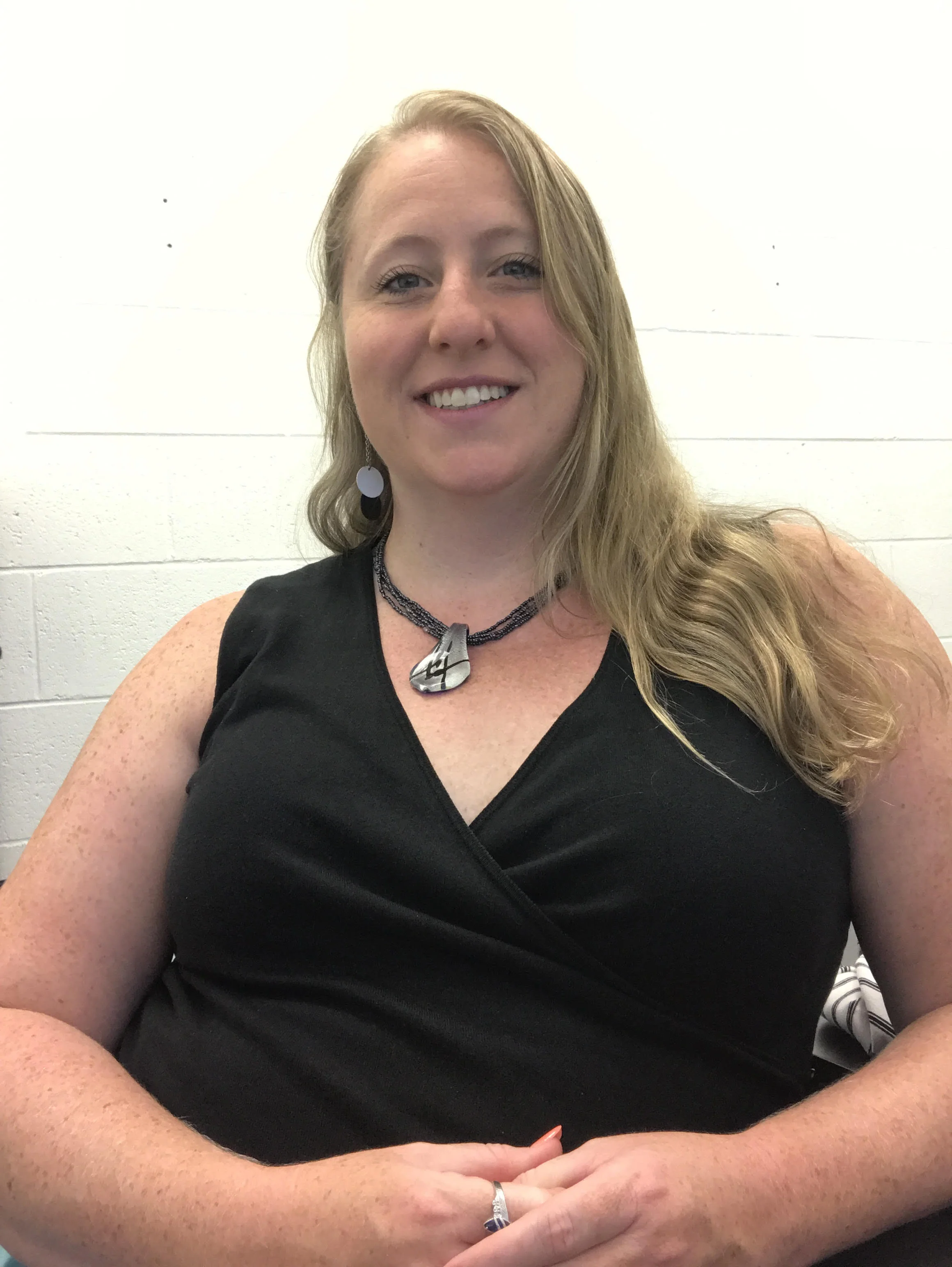
Meet AWC Vice President & Program Chair, Jessica Jones
unnamed.jpg

AWC: When did you start writing?

I was fascinated with literature from the moment it started spilling from my MeeMaw’s lips. She started reading to me when I was a baby and I still can’t get enough. She read to me so much that I memorized my favorite books. By age 2, I would sit with a book, recite the words from memory. Flip the page—repeat—flip the page—repeat. People thought I was a crazy prodigy who could read at 2 years old, but no, I had it all memorized.

I was so hooked that I started writing my own short stories in 1st grade. One was about a horse, and one was about a blue wedding dress. This was the ‘90s, before such things were popular. At 7, I thought it was incredibly hilarious to write about a literally blue wedding dress who was blue (sad) that she was different than everyone else.

I started writing poetry at 15. The angst of young passions left me confused, and swimming with hormones, and desperately trying to make sense of everything happening internally and externally. Poetry came pouring out. I did very little except pick up the pen. I quickly progressed to reading Langston Hughes and writing my own poetry responses. 

My poetry tends to be an outlet for my passions: relationships, social injustice, idealism. It wells up and spills out whenever it wishes.

AWC: What are you working on now and why?

I’m writing prose poetry and sestina right now. I’ve been concentrating on themes of loss because MeeMaw was just diagnosed with lung cancer and the only thing that makes sense is to write, and cry, and write some more. 

It’s interesting how often that’s happened—I think intense emotions tend to spill out into writing and the next thing you know, the computer screen is a complete blur and you’re doing everything you can to see the words as you type them. I remember writing my thesis for my English Master’s at the University of South Alabama. Since I was concentrating in Creative Writing, I  wrote a memoir with poetry at the beginning of each chapter and analysis at the end of each chapter. It’s collage style, with the central story focusing on my trip through Europe at age 16, and thematically related flashbacks throughout.

I began writing about Austria and how I bought my mom a souvenir with an Edelweiss because she loved that song in The Sound of Music. I thought that was the gist of it, until I found myself blubbering on about how my mother had always dreamed of visiting Austria and how I freaked out when she mentioned going with me and my school friends because she would totally cramp my style. It hit me out of nowhere that I was a selfish person—an absolute spoiled brat who had robbed her mother of her dreams when she’d done nothing but encourage mine. The tears flowed and flowed, and the writing was my most honest work.

Catharsis aside, funny stuff happens too, and I laugh out loud more than I cry. I remember writing the flashback that I titled, “Unbound Passion” and I laughed so hard my stomach hurt. I was 4 years old and I was absolutely in love with Matthew McKinley—a boy in my Kindergarten class. I thought he was so hot. I called him, “my hero” because I watched a lot of princess movies back then and some boy was going to save me from something and make me fall in love with him, no matter what. I saw him lining up for lunch one day, and I truly could not resist him. I ran across the room, knocked him down into a chair, and started kissing him all over the face quite energetically. He proceeded to toss his head quickly side to side and scream for me to stop. He resisted in every way possible, but I would not give up. My teacher, Mrs. Turner, quickly came over and lifted me off of him. She sent me down in the lunch line and tried, rather unsuccessfully, to stifle her uncontrollable laughter. much the same as I am doing, even now as I am typing out this interview answer.

So, I am writing these things now because I can’t help it. Just the same as always. These things come bursting out of me and I can’t help it. I would never change it for a moment.

AWC: Tell us about yourself in the daily.

I am the creative director for the City of Orange Beach. I live in Gulf Shores, Alabama, and am married with two step children. I teach, and oversee programming for children and adults in Orange Beach.

I also coordinate special events. It’s a southern thing, and since there’s something special and eventful worth doing all the time, it is one of my favorite aspects of my job. I am also the founder of a nonprofit, Poetic Presence.
Guest User
Meet AWC Treasurer Hank Henley

AWC: So, Hank, tell us a little bit about yourself.

Hank Henly: I was in denial and disbelief on my last birthday when I asked Teri how I could possibly have reached my present advanced age. She gave me a succinct and profound answer—“you lived.”

I still have a hard time adjusting to the idea that I’m 60 years old. In many ways I still feel like I did in my 20s, but despite the stunted emotional maturity that keeps me feeling young, there are days my body reminds me that my salad days have passed.

AWC: Interests?

Hank Henley: Well, I’ve already mentioned Teri, my wife of 28 years (truthfully, the actual number could be anywhere between 25 and 30, but 28 feels right)—she takes up a lot of my time. (Note to whoever keeps the AWC mailing list--please don’t add her). 

Travel is a big interest of ours. Teri and I have visited 35 or so countries together—Vietnam, China, Cuba, and Russia, just to name the Communist nations. This year the pandemic has us dividing our time between our lake house in rural Winston County and our “regular” house in Suburbingham.

My rescue mutt Jasper is a 72-pound chunk of boundless enthusiasm, infinite love and complete idiocy as well as an endless source of fascination and amusement. Jasper thinks the whole COVID thing has been awesome since we’re with him all the time these days.

AWC: Occupation?

Hank Henley: I might be retired but I haven’t quite decided. I spent most of my working years in what used to be called the college textbook industry. It paid the bills, but I was on the road a lot. When you spend 150 nights or more each year in hotel rooms for something like three decades, that adds up to, well, it adds up to a lot of nights in hotel rooms. I’ve got stories about my time on the road, but the life of a road warrior isn’t as interesting as you might think.

A couple of years ago I got downsized along with scads of other great people. I was a bit of collateral damage in a dying corner of publishing. Since then, I’ve done some freelancing and found other honorable ways to make money when I’ve been of a mind. I’d probably be officially retired except Teri tells me that’s not an option for me while she’s still professoring, and she isn’t ready to hang up the cap and gown just yet.


The dream library is complete.

The dream library is complete.

AWC: Tell us about your writing?

Hank Henley: Frankly, I do more reading than writing. I’m a voracious reader. When we built our getaway place, I had one demand--it had to have an awesome floor-to-ceiling and wall-to-wall bookshelf, complete with one of those sliding library ladders. I am happy to report that I’ve realized that dream and can now die happy.

This year, I’ve been a beta reader of two novels written by AWC members. That was really rewarding, and I look forward to seeing both books in print soon. I’ve completed three pre-published novels of my own, each in its own genre—rom-com, southern romance and comic urban fantasy. I’ve never been brave enough to turn one of my masterpieces loose on the world, but I should probably get over that.

I’ve started work on a military sci-fi, but my timing couldn’t be worse since key plot elements include a virus and civil disruption and opening that manuscript just feels weird right now.  

AWC: What is your role with our organization?

Hank Henley: I’m the AWC treasurer. Before that I served as the Membership Chair. The treasurer is the person who makes sure we don’t spend more money than we take in. That means I have to be the meanie at board meetings who grumpily points out that we can’t afford whatever it is we are talking about just before I get outvoted and we spend it on that thing anyway. 

AWC: Well this interview has certainly gone on long enough.  Is there anything else you want to add?

Hank Henley: All kidding aside, it has been an honor and privilege being part of the AWC for however many years it has been. It is a true joy serving the members of our organization and our board. It’s been an even greater pleasure to watch our members develop and flourish as writers. I’ve seen first-hand how the AWC affirms and supports so many great writers from Alabama and beyond.  AWC—you are my tribe.


Guest User
Meet AWC Historian Dean Bonner
0-5.jpeg

As an all-volunteer group, the AWC Board wants members to get to know those who represent them and help manage the logistics of this organization. This is part of series in which AWC Board members interview themselves. We hope you enjoy it.

Hi Dean Bonner. What kinds of things do you write?

Mostly humor and memoir, but I write a little poetry when it strikes me.  I can’t force poems-- they arrive suddenly and infrequently.

How do you write?

It’s 90 percent subconscious.  I’ll take a one-line idea and do my normal routine of swinging a hammer and such while stories write themselves.  Occasionally an item needing sorting out surfaces while I work, shop, et cetera: “Use this phrase; delete that, move that idea up/down in the order of the story.”  When I sit down at the keyboard or typewriter, it’s largely just typing up the story.  I’ll do two or three rounds of editing afterwards, but I seldom change much of the material. 

What prompted you to write?

It was an outlet in school, where I was bullied for years.  I got praise for my rudimentary efforts.  Then I didn’t write anything for years, until my college work and job required it.  But those honed my skills in writing condensed stories.  Especially writing intelligence briefings and analyses.

But why I got serious with my writing was largely to preserve a lot of family stories so they wouldn’t be lost forever.  That became the book, which led to a newspaper column and magazine work, and a lot of other things that followed. 

What is your latest effort?

Well, there are two. I got a television development contract from an LA producer I met at an Albertville, Alabama book event put on my now-defunct PDMI Publishing.  Where my original memoir collection is largely humorous, with the darker side of it being the deafening silence of what is left unsaid, the TV material puts both the humorous side and dark side right out there in a sort of Southern Gothic dark comedy.  

The TV project has a working title of Tar Nation, based on my book I Talk Slower Than I Think.  I cowrote the pilot screenplay with a magnificent writer, Heidi Carroll.  Our plans to shop it around some more were put on hold when some major film conferences were cancelled by COVID.  But the pilot placing as a Second Rounder / quarterfinalist in the 2019 Austin Film Festival should give it a boost, once we can pitch it in person again.

The second project is called NC-34.  It’s an audio show in a sort of Burns and Allen format.  It weaves the tidbits of random humor that my brain spits out daily into a show that is set in the living room and kitchen of a middle-aged couple who have odd friends, neighbors, and relatives. 

Is it odd to interview yourself?

Not really.  I talk to myself sometimes, and I win most of the ensuing arguments. 

What is the best way to make your garden, or yourself, grow?

With the help of detractors. 

Guest User
A conversation with Kerry D. Brackett on poetry, community, and building platforms for local voices.

It’s an honor to talk to member Kerry D. Brackett, (Poet Kerry B), an award-winning spoken word artist and author who uses hip-hop and jazz influences for his poetry. He is currently pursuing his doctorate and serves as a faculty member in the Division of Humanities & Communications at Miles College in Birmingham, AL.

0-5.jpeg

I want to start with that first question writers often wonder about each other, namely, the beginning of the writing. Tell us a little about how you came to writing and poetry--what part of it called you--and who encouraged you along the way.

Kerry B: I started become serious in writing poetry when I was a freshman at Berea College. I would write poems to help me cope with being far away from my hometown of Birmingham, AL. My roommate listened to most of my poems so I can see what I needed to edit. A lot of people read my poems on Facebook, including family and friends. I was serving in the Navy when an old college friend asked me when was I going to publish a book.

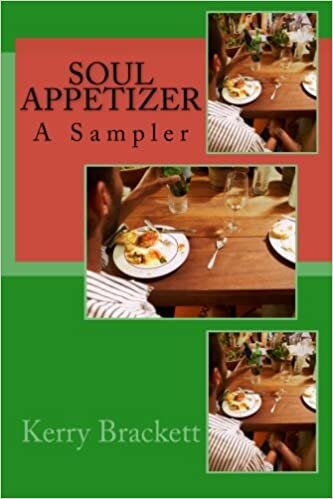
My first self-published chapbook Soul Appetizer: A Sampler was released in 2012. Due to support from family and close friends, I am able to keep writing and performing poetry today.


The role that family and community plays in supporting writers is critical for so many writers. I feel like we start off writing poems because we love it, because we can’t help it, because we can’t stop—and then entering the world of publishing can be a nightmare, a distraction from writing and investing in others. On that note, self—publishing offers one way for a writer to have more control and flexibility in the content of their book, and without tying up resources and energy in seeking publishers. That said, your most recent work is being published by Winn Publications. What would you tell poets who are trying to decide whether to self-publish their chapbooks? And what led you to move towards being published by a publisher?

Kerry B: Self-publishing was definitely a learning experience. I would tell anyone that is interested in self-publishing to make sure they are fully committed in their project. Self-publishing means you're in control of EVERYTHING (marketing, formatting, editing, etc.) While it sounds very promising, it's a lot of work as well.

I wanted to have the experience of getting published by a publisher, mainly because academia still frowns upon the stigma of self-publishing. I am thankful for having a great support group in helping me promote all of my endeavors, which is important for any writer. 

Tell us more about Birmingham--your roots, your relationship to it, your favorite places, the ghosts, the people who come alive for you when you write.

Kerry B: Birmingham is what I call home. I was born and raised here. Every city that I travel to for performing poetry, I make sure they know that I am a son of Birmingham. I look to the mountain to see Vulcan's light.

My grandmother lives a couple of blocks away from the house of Angela Davis. Some of my favorite places to go are Legion Field (especially during the Magic City Classic), Miles College (where I currently teach English and creative writing courses), and the Civil Rights Institute.

When I write, I can hear the voices of those who couldn't speak for themselves. This is especially true for topics that need to be addressed. I am also a co-owner of the Majesty Lounge in Bessemer, where we have a platform for artists to share their gifts.

I can’t wait to hear more about Majesty Lounge, which you co-own with your wife, but before I get to that, I’m curious if there is any particular place in Birmingham that is a personal favorite, a source of reconnection?

Kerry B: My favorite spot would have to be my backyard, especially when it rains. It takes me back to when my grandfather, brother, and the men in my family would have deep conversations on my grandfather's porch. It always rained when we did. I love to go to my backyard and reflect while watching the rain. It's very soothing.

Your first two poetry books seem to center foodways and food traditions. How does food and poetry mingle in your work? And how is Surviving Myself, your most recent book, different?

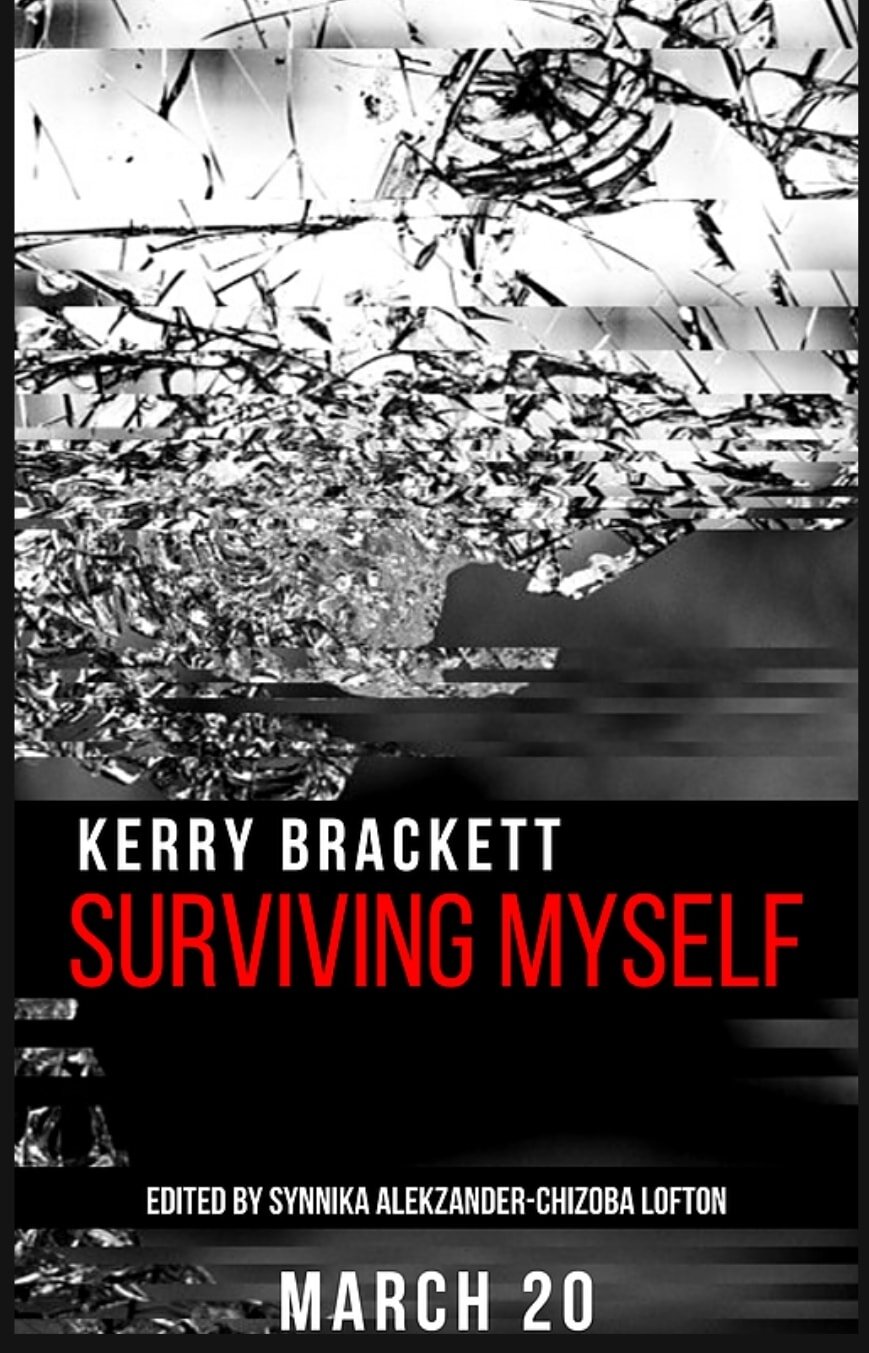
Kerry B: I used food references for my first two chapbooks because I noticed how easy it was to write when food was around (I love to eat). Poetry and food have an interesting relationship. Each open mic/reading that I've attended has been a great experience when food was involved. Some of our most serious conversations were a little easier to bear when food/drink is involved (coffee, alcohol, etc.) Surviving Myself was a different turn in that I addressed issues that were a challenge in my daily life. I wanted to use my writing to express my feelings and thoughts about each topic.

I’ve heard Birmingham poets raving about it, but I’d like to ask you, personally, to tell us more about Majesty Lounge.

Kerry B: The Majesty Lounge opened in Bessemer, AL in 2018. My wife and I wanted to open a platform for artists in various genres to truly show what they can do in front of an intimate audience. We've had numerous poets and spoken word artists from around the country to perform in our venue.

We just celebrated our 2nd anniversary on May 30th. The venue is also open for anyone looking for a venue for birthdays, mixers, parties, etc. 


The role of Historically Black Colleges is inspiring, and I don't read enough media talking about the way in which HBC's cultivate and sustain and nurture Black writers. Can you share a little about your experience with this--both the joys and the challenges--at Miles College? I'd also love to know how to share Miles' literary journals and groups with Alabama writers.

Kerry B: I truly enjoy teaching creative writing, especially poetry, at Miles College. It's truly inspiring to see a student's eyes light up when they read poems from the likes of Sonia Sanchez, Langston Hughes, Nikki Giovanni, etc. Some of the students have an interest in writing their own poems and love to tell me about their writing experiences.

One challenge that keeps occurring is that students don't see the financial benefits of creative writing, compared to the lucrative STEM majors. I always tell them that employers love to see recruits with great writing and critical thinking skills.

I started the Golden Word Movement (the campus poetry club) in 2018 to provide students a platform to share their poetry writing. We've competed in poetry slams, performed at open mics, and encouraged the campus to look at poetry/spoken word in a different light. The campus journal, Sanctuary, is another platform for student writers to show their work. 

You can learn more about our upcoming virtual poetry slam on the Majesty Lounge Instagram page, as well as our virtual open mic on Thursdays. We are planning to open back up for a live show in the Fall. We also have a gift shop (shirts, hats, bags, etc).

0-5.jpeg

Thank you so much for taking the time to share your work, your life, and your creations. I’d like to end with one of your poems, and let you speak and share from there. I’d also like to encourage fellow Alabama writers to support by buying books, inviting speaking engagements, and becoming part of the poetry scene at Majesty Lounge.

“Uncommon Hero” 


I’ve sailed the Seven Seas 
As a United States Sailor,
Defending this nation 
That once called my people their property. 

I share the same courage as
Crispus Atticus,
Willing to die for freedom. 
Yet, I’m not recognized as equal. 

I wore the same uniforms, 
Received the same training, 
Fought in the same wars... 
But there are no parades for me. 

No “welcome home” signs. 
No chants of “USA!” 
Even in full uniform, I’m asked 
For my military ID on Veterans Day. 

I bled the same blood. 
I cried the same tears. 
My brothers and sisters died the same deaths.
Yet, I’m just an uncommon hero. 


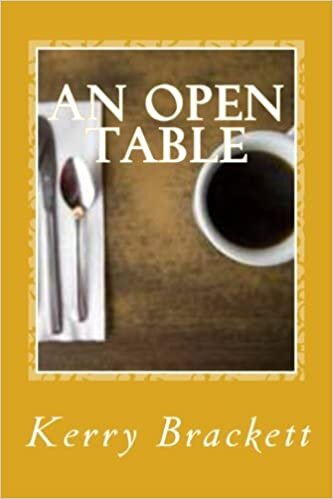
Kerry Brackett (Poet Kerry B) is an award-winning spoken word artist and author who uses hip-hop and jazz influences for his poetry. Participating in open mics and readings throughout the nation, he is known for his rhyme scheme and style. His poetry is recognized to carry powerful messages, along with a passionate delivery. Kerry B is the author of the poetry books Soul Appetizer: A Sampler, An Open Table, and the new chapbook Surviving Myself. He has released four spoken word CD’s: Midnight Sunrise, Soulful Seductions, and Urban Griot, and the award-winning album Kadence of a Poetic Gentleman. Kerry B won a National Poetry Award in 2014 for “Freedom Poet of the Year.” He is also a proud member of Phi Beta Sigma Fraternity, Inc. Kerry B has a bachelor's degree in African and African American Studies and a masters degree in English & Creative Writing. He is currently pursuing his doctorate and serves as a faculty member in the Division of Humanities & Communications at Miles College in Birmingham, AL. Along with his wife, Kerry B is the co-owner of the Majesty Lounge in Bessemer, AL. 

Alina Stefanescu serves as Website Editor for AWC.

Guest User
A statement from the AWC Board
450px-Black_photo.jpg

A little more than six months ago, the AWC finalized a major transition -- from being a "Conclave" to being a Cooperative. We made that change carefully, deliberately, and with a renewed commitment to "Engaging and nurturing a diverse community of Alabama writers." It wasn't simply a name change. It reflected our attitude, what we expect from ourselves. It signaled our larger aspirations for the kind of inclusivity and tolerance we are committed to fostering amongst Alabama writers everywhere.

As communities across America are again -- still -- squarely facing the pain of persistent racism and racist violence, and as they also express their mounting anger and frustration at waiting for meaningful systemic change -- the Alabama Writers' Cooperative's position is unwavering: we value the lives, contributions, ideas and ideals of people of color, whether they're writers or not. We recognize the longstanding struggle for racial equality in America is far from over, and we as an organization feel a duty to advance that vital effort on behalf of a membership that reflects an array of races, religions, and ethnicities.

Above all, our organization values curiosity and empathy for our fellow human beings -- as those values (curiosity, empathy) are essential to any authentic writing life.


Alabama has a long history of being on the wrong side of history when it comes to Civil Rights and social justice issues, particularly as it relates to its Black citizens, who have been central to its economic and cultural development over its 200-plus years of existence. The AWC has been in existence for almost half of that history. Six months ago, we formally announced to Alabama (and everywhere else) our organization’s path and values. We pledge, now and in the future, to work with renewed vigor to help bridge gaps, right wrongs, and provide platforms for voices that need to be heard as our state and nation forges a new path toward real and meaningful change for the better.​

Guest User
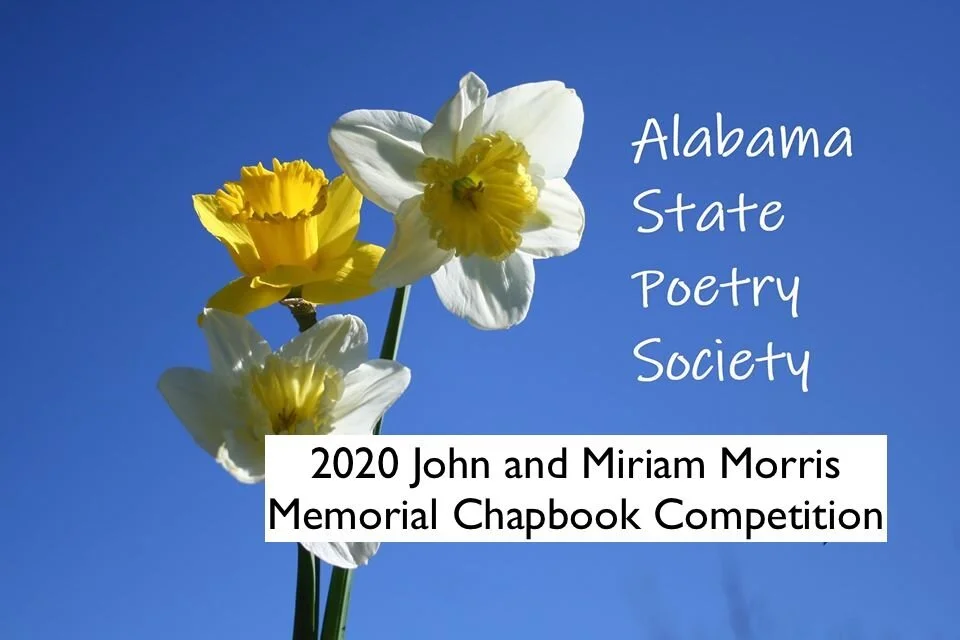
Annual John & Miriam Morris Memorial Chapbook Competition
95815163_949459098852405_3702610319978266624_o.jpg

ALABAMA STATE POETRY SOCIETY  ANNUAL 

JOHN AND MIRIAM MORRIS MEMORIAL CHAPBOOK COMPETITION

Deadline is May 31, 2020.

Winner receives $100 and 25 copies of his/her winning chapbook.  

How to enter:

  1. You don’t have to be a current member of ASPS in order to enter this contest.

  2. Submit 20-24 total pages of poetry, no more than one poem per page, however a single poem may continue for more than one page.

  3. Include two title pages, one with author information, and one without.  Author information should appear on only one copy of the title page and nowhere else on the manuscript so that manuscript can be read blind.

  4. No need for a theme, index, intro, or acknowledgement of previous publications unless you just want to include these.  Poems may be previously published if poet retains all rights. A table of contents can be helpful.

  5. Send entry with $15 reading fee (made out to New Dawn Unlimited, Inc. and postmarked by May 31, 2020) to:

    New Dawn Unlimited, Inc.

    Morris Memorial Chapbook Competition

    1830 Marvel Road

    Brierfield, AL 35035

Previous chapbook winners can be purchased through New Dawn Unlimited, Inc at 1830 Marvel Road, Brierfield, AL 35035 for $5 each. 

A complete list is available at NewDawnUnlimited.com under the "chapbooks" button.

ASPS sponsors both Fall and Spring contests as well as the Morris Chapbook competition.  Info is available through the Muse Messenger newsletter or online at the Alabama State Poetry Society website..

Guest User
How State Poet Laureate Jennifer Horne Celebrates Poetry During a Pandemic
A still from the video readings.

A still from the video readings.

For National Poetry Month this past April, the pandemic put a stop to many readings and forced the poetry community to find other vehicles for celebration. Alabama State Poet Laureate Jennifer Horne did what she has often done in the past—she mobilized an effort from the grassroots and managed to create a gift for Alabama poetry lovers.

A Little Spark, A Love for Poems, and A Lot of Social Media

After deciding to honor Alabama poets by sharing a reading daily, Horne realized she would need to use social media. So she created an event, “Alabama Reads Poetry”, on Facebook, and invited the public to join her in reading a poem on their preferred social media and use the hashtag #ALreadspoetry. To quote:

“In the absence of getting to see people read in person, my hope is that this ongoing statewide event will generate a host of online poetry readings. I also hope that we'll keep using the #ALreadspoetry hashtag for future events and announcements to link our Alabama poetry community. Feel free to include a link if you have a new book. However you do it, that's the right way--just read us all a poem!”

Then Horne slowly, carefully, prodigiously read a poem each day and shared the reading on twitter from the Alabama Poet Laureate account.

By the end of National Poetry Month, Horne had created a all-over-Alabama digital archive of readings featuring the work of the following Alabama poets:

  1. Andrew Glaze (see above)

  2. Brian Voice Porter Hawkins

  3. Ken Autrey

  4. Carter Williams Martin

  5. Bonnie Roberts

  6. Emma Bolden

  7. Ashley M. Jones

  8. Daniel Blokh

  9. Ramona Hyman

  10. Jeanie Thompson

  11. Jessica Temple

  12. Charlotte Pence

  13. Georgia Ann Banks-Martin

  14. Deidra Suwanee Dees

  15. Kwoya Fagin Maples

  16. Mike Wahl

  17. Anne Markham Bailey

  18. David Kopaska-Merkel

  19. Rodney Jones

  20. Jerri Hardesty

  21. Jennifer Horne

  22. M. P. Jones

  23. Lauren Slaughter

  24. Sue Brannan Walker

  25. Ramey Channell

  26. Tina Mozelle Braziel

  27. TJ Beitelman

  28. Alina Stefanescu

  29. Harry Moore

We are grateful and inspired by this beautiful collection—and yet another reminder why our state values and treasures our state poet laureate so much.

Guest User
Literary Community During Pandemic: Thriving While Cancelled
IMG_5621.jpg

Last year, no one anticipated the way literary, domestic, and economic life could change as the result of the COVID-19 pandemic. Even our science fiction writers didn’t quite prepare us for life under shifting quarantine, with it’s sports-lacking spring and its absence of barbecue. Important literary events have been cancelled, including the Alabama Book Festival in Montgomery (which will take place next year) and Mobile Literary Festival (which will be rescheduled at some point in the future).

Some Alabama literary events are continuing in their usual form. For example, the Alabama Writer’s Forum High School Literary Arts Awards took place last month, with Lenore Vickery, Susie Paul, James E. Cherry, Caitlin Rae Taylor, and James M. Hilgartner serving as judges. Visit the website for an exciting list of up-and-coming young Alabama writers.

Other Alabama groups are building alternative venues for literary community which can be accessed online. The Huntsville Literary Association and the Alabama State Poetry Society have been sharing readings, writing prompts, and various other forms of craft fun in their Facebook groups. At times of social difficulty, emotional difficulty is not far behind. We, as a community of writers and readers, are working to find ways to be support, encourage, and nurture each other in hope and life.

The Economic Impact

For the writers whose livelihoods have been impacted by job loss or furlough, national organizations have made efforts to help provide financial relief. If you have been impacted, consider applying for Artist Relief grants. There are countless other organizations, both national and local, currently offering grants and aid to writers. Here’s a list. The Author’s Guild also offers free webinars and financial advice and assistance to working writers of every genre, including a #Support Authors Social Media Campaign for those struggling with the release of new books.

State Poet Laureate’s National Poetry Month Readings

Our beloved State Poet Laureate, Jennifer Horne, has been celebrating National Poetry Month by reading a different Alabama poet every day on social media. She hopes that we'll keep using the #ALreadspoetry hashtag for future events and announcements to link our Alabama poetry community, and encourages poets to include a link if they have a new book.


Magic City Poetry Festival

Birmingham’s fabulous Magic City Poetry Festival was scheduled for April until COVID changed the landscape. After mourning briefly, the Board quickly shifted some aspects online, though it currently plans to reschedule readings, workshops, and features. In the meantime, the celebration of poetry continues with the 2020 Virtual Book Fair featuring the work of poets in the 20202 festival as well as the brand-new, just-bloomed Shelter in Magic Reading Series, an online video reading archive of Birmingham-connected poets reading short poems in under three minutes. Stay tuned in for more on that.

And here’s the State of Birmingham Poetry Address by MCPF Director Ashley M. Jones.

PEN America in Alabama

Many of you know that the PEN America Birmingham Chapter opened last year. This put the national power of PEN in the state of Alabama, where we can promote and support writers covering difficult topics or writing against the grain. We are so proud of that accomplishment as well as its Co-Directors, Ashley M. Jones and Alina Stefanescu.

In addition to offering a Writers’ Emergency Fund to support those struggling with loss of income or livelihood, PEN America has been actively trying to promote free expression and support writers through a limited-run podcast, "The PEN Pod," to provide regular updates and conversations about literature & free expression, and provide an outlet for our canceled/postponed in-person events.

What matters is that the poem gets written; it does not matter if I write it. You cannot humble yourself yourself. You must be humbled.
— Dan Beauty-Quick, "January Notebooks"

Podcasts

Ear buds and headphones are the quarantined family’s best friend. Podcasts offer auditory engagement, whether for entertainment, craft, or personal development. A few podcasts that writers might find worthwhile:

  • The Longreads Podcast features interviews, essays, reporting and discussion from the home of the best longform stories on the web.

  • The S-Town podcast is a must-hear for local history buffs. Hosted by This American Life’s Brian Reed, S-Town is a podcast in chapters about a man named John who despises his Alabama town and decides to do something about it. He asks Brian to investigate the son of a wealthy family who’s allegedly been bragging that he got away with murder. But then someone else ends up dead, and the search for the truth leads to a nasty feud, a hunt for hidden treasure, and an unearthing of the mysteries of one man’s life.

  • Paranormal Alabama is Will Hopper’s paranormal podcast about everything unexplained in Alabama. If you like ghosts, thumps, spooks, and uncanny objects, this is worth your listen.

  • The White Lies podcast follows the 1965 murder of Rev. James Reeb in Selma, Alabama. Three men were tried and acquitted, but no one was ever held to account. Fifty years later, two journalists from Alabama, including Birmingham’s Chip Brantley, return to the city where it happened, expose the lies that kept the murder from being solved and uncover a story about guilt and memory that says as much about America today as it does about the past.

  • The Moth Radio Hour is a weekly series featuring true stories told live on stage without scripts, notes, props, or accompaniment. Each Moth Radio Hour mixes humorous, heartbreaking, and poignant tales that captivate, surprise, and delight audiences with their honesty, bravery and humor. You can listen it on your local public radio or stream it online.

  • The PEN Pod provides regular updates and conversations about literature & free expression, and provide an outlet for our canceled/postponed in-person events.

  • If you’re looking for local book reviews by a bibliophile, look no further than Jacob’s Red Star Reviews. Who knows—maybe Jacob will review your book if you send him a copy?


Virtual Book Clubs & Library Events

Alabama librarians continue to serve their communities through online book clubs, readings, and workshops. Book collectives and clubs are working alongside them to keep books and words alive in conversation and social life. All the events below are free and open to the public.


Writing Prompts & Free Workshops

  • Ernest & Hadley Booksellers is offering a free online writing workshop with Susan Zurenda on May 28th. Register online before spaces fill up. The workshop will cover both the basics of story and the importance of genuine emotion in stories. It will also examine how writers achieve success in creating human emotion in contrast to why writers sometimes fail in this essential endeavor. Ample illustrations will be provided, some from the Susan’s novel, Bells for Eli, and participants will be given writing prompts with time to write, followed by real time feedback.

  • Poetry Highway offers free poetry writing prompts.

  • Those wanting to explore poetic form can play with Jacob Jan’s free online Pantoum Generator.

  • There’s nothing like a walk in the woods to get the words moving again. If you decide to take a hike, please do it safely. Remember that social distancing rules still apply on trails and footpaths.


Submission Calls & Opportunities

  • COVID LIT, a new magazine, spreads art, poetry, and prose using the disease's name. What makes this project a bit different, however, is that rather than accepting submission fees, we require writers to donate at least $3 to a nonprofit of their choice. Write, submit, and assist with the same hand.

  • Pangyrus has launched an online series with quick turnaround: “In Sickness & In Health: Life in the Pandemic and Beyond.” Editors are seeking well-crafted, thought-provoking writing and multimedia storytelling in every genre. No deadline.

  • Sky Island Journal is seeking poetry, flash fiction, and creative nonfiction from around the world that provides culturally diverse perspectives on, and experiences with, the COVID-19 pandemic. Deadline: June 30th.

  • For its “Covid-19 in the South” call, The Bitter Southerner is accepting pitches and full pieces focused on individual and community responses to the coronavirus. How are people across the south coming together in response to the pandemic? No deadline. 

  • Appalachia Journal is seeking essays responding to COVID-19 for its “Mountains and a pandemic” call. Thoughtful prose related to wilderness, mountains, and river adventure and environment during this time are being reviewed. Deadline: May 20.

  • The Center for Interfaith Relations is seeking “Sacred Essays” exploring “connection, contemplation, and common action in times of social distancing.” Deadline: June 2.

Guest User
Brent Stauffer reviews Ghostly Demarcations by Joe Taylor.

What follows is one AWC member sharing their thoughts on a new book by another AWC member. We are grateful to Brent Stauffer for his close reading of this short fiction collection by Joe Taylor (Sagging Meniscus Press (June 1, 2019).

“Unabashedly conventional horror tales with an understated but remarkable lead character.,” says Kirkus Reviews.

Joe Taylor’s story collection Ghostly Demarcations is a meditation on friendship, growing up in the South and the nature of haunting. Taylor’s voice rings true, with a lyricism woven from homespun cloth, shot through with threads of otherworldly gold. Only the fantastical elements of wraiths, poltergeists and the like remind you that perhaps this isn’t, strictly speaking, a memoir.

We first meet our unnamed hero at ten years old, in rural Kentucky, as his best friend Galen describes his recent ghost sighting. (The book is, in part, dedicated to a person named Galen. Maybe these stories are more true than an adult brain can comfortably fathom!) Their unbreakable bond is a main fixture around which all the events described, spooky or otherwise, revolve.  This is true even when the arcs of their lives have bent away from each other. In “Angel’s Wings,” where Galen is in the Navy, worlds away, he is yet heard by his friend in a time of great need via a rinky dink homemade radio. Not only does Galen figure prominently in every story of the collection, he usually appears in the first page, if not the opening sentence itself. In “Faithful Companion,” which takes place during his days at the University of Kentucky, the narrator remarks, “Ha! Let UK’s atomic clock click it’s loudest: what care I, with such a faithful companion close by?”

   Another near constant element of these tales is a wry humor, sometimes self deprecating, other times displayed with postmodern flair. Taylor teases us a couple times with the nameless nature of our protagonist:  in “I Am the Egg” elderly, clueless  Mister Howard rifles off a list of incorrect monikers. (We get a good sense of what his name isn’t!) In “The Perfect Ghost Story, Plus One,” when a girl introduces herself by name, our hero tries to reciprocate only to be rudely interrupted!

Underneath the humor and homespun texture of these stories, however, lurks the   constant threat of an incursion of the supernatural. Time after time, Taylor regales the reader with a charming tale of growing up in the New South; and when a comfortable mood is firmly established, the bottom drops out with the arrival of something that is Not of This World. More than once a reader might have to go back over a passage for a missed clue, only to find that the abruptness of the shift is, indeed seamless. After continuing to encounter these transformations, one develops a slight tickle in the back of the brain as the story unfolds in stately fashion. The anticipation, subconscious or not, of a surreal explosion creates a pleasing background tension that keeps the reader awake and engaged. 

The combinations of real and unreal, humorous and poignant, full fledged characters and well crafted master storyline, create, in Ghostly Demarcations, an overall delight. The exploration of friendship over time is laid across the known and unknown, in particular, quite naturally, the mysterious dynamics between Life and Death. The reader is left with a profound sense that life, with all its unexpectedness  and certainty of a tragic end, is well worth the living.

Guest User
Get to know AWC Board Historian, Clarence Bonner.
0.png

Dean Bonner was born and raised in rural Georgia but can claim naturalized citizenship in Tallapoosa County, Alabama and Virginia Beach, Virginia. As a retired Coast Guard veteran. Bonner left the tarpaper shacks of Appalachia for a long military career, rising through the enlisted and officer ranks. He was a skilled Morse telegrapher and a calming voice during many search and rescue cases. He left a town of 300 souls to travel the world, living in Boston, New Orleans, DC, and even on the island of Guam for a couple of years. 

During his 30 year Coast Guard career, he earned his BS in Security Management and still maintains the highest international certification in Security Management, Certified Protection Professional.  He served his final eight years of active duty as an Intelligence Officer. 

Dean is a skilled Studebaker car mechanic, tube radio repairman, firefighter, and a weekend gold prospector.  His upcoming projects include recording two albums of his original humor and writing a new compilation of short stories. His wife Patricia, a multi-talented artist, shares these same interests. Together, they travel and spend time at homes in Alabama and Virginia.

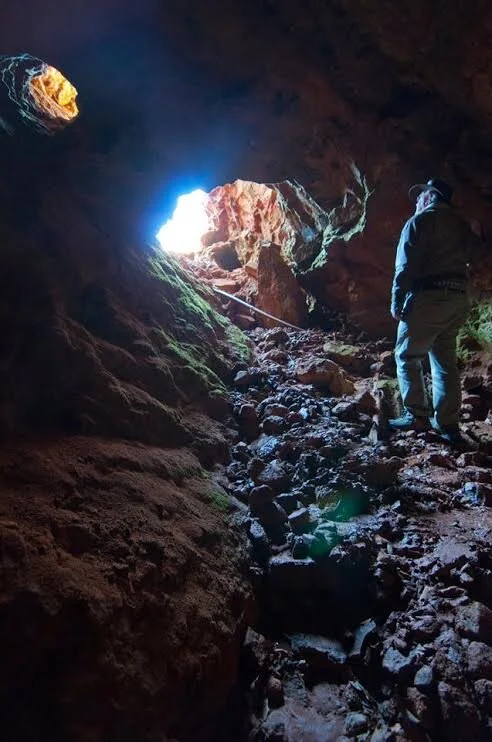
Dean was a weekly columnist for The Dadeville Record before he began work as a freelance writer for Lake Magazine and Lake Martin Living magazine. His favorite assignment to date was exploring the Hog Mountain gold mine where his grandfather and great-grandfather worked. 


His poetry is published in two collections called The Breaking and A Stormy Beginning, by Scars Publications.  His work was featured in the February 2016 issue of Down in the Dirt literary magazine. 

He wrote feature articles for The Alexander City Outlook, Dadeville Record, Lafayette Sun, and for the arts magazine The Revelator

He was a contributing editor for Lisa Ditchkoff's book, The Girl with Caterpillar Eyebrows, about educating herself while she grew up in hiding from her father, an associate of Boston mobster Whitey Bulger.  

Dean was a 2013 winner in nonfiction in Alabama’s largest writing competition, the Alabama Literary Competition, organized by the Alabama Writers' Conclave. He competed against writers nationwide with his nonfiction short story "Seeking Asylum" about visiting his mother in the state insane asylum when he was three.  

Dean has a development contract with Los Angeles-based Council Tree Productions for a television series called Tar Nation that is based on his book I Talk Slower Than I Think.  He co-authored a television pilot screenplay with Heidi Carroll for Tar Nation that placed as a Second Rounder / quarterfinalist in the 2019 Austin Film Festival.

And now you know a little bit more about a person who donates his time and skills to serve the members of Alabama Writer’s Cooperative as historian. Be sure to reach to him if your interests (or paths) cross.

Guest User