newsback.jpg

Blog

What’s happening in the Alabama writing world…


Posts by Date
Posts By Category
 
 
Meet Becky McLaughlin, AWC 2019 Conference Faculty.

AWC is thrilled to welcome Becky McLaughlin to Orange Beach as faculty for the 2019 Conference. She will be facilitating the following three workshops at the AWC Conference this November:

Psyche  Character  Plot

Using the concept of the psyche for building character and generating plot, this workshop will show you how psychoanalytic concepts such as the mirror stage, object small a, repression, screen memory, fundamental fantasy, primal scene, desire, and the drive can help you create a psyche, out of which comes character and thus the conflict of plot. Even if a reader is never directly shown a character’s repressed material, a good writer knows that conscious action is the result of the workings of the unconscious, and thus every good writer must know what his or her characters are repressing. You might ponder, for example, how Doris Lessing’s Martha Quest was unconsciously shaped by her mother’s not-good-enough parenting skills or what the unconscious effects of arson were on William Faulkner’s Sarty Snopes or what drives Manley Pointer to steal Hulga’s artificial leg in Flannery O’Connor’s “Good Country People.”

Nervous Nellies, Pervs, and Psychos

Want to write a twisted love story featuring two tortured neurotics, one a beautiful hysteric and the other a lonely obsessional? Intelligent erotica based on the perverse sexuality of the exhibitionist, the fetishist, or the voyeur? A psychologically informed horror story with a psychotic killer as your central character? In this workshop, you will learn what psychoanalysis has to say about the psychical structure of the neurotic, the pervert, and the psychotic (i.e., what makes them tick) so that your fictional characters will have the ring (not to say the tics!) of psychological authenticity.

The Unconscious, Automatic Writing, and Collage Poetry

The Surrealists and their art, whether literary or visual, were deeply influenced by Sigmund Freud and his attempts to access the unconscious, the concept around which all of psychoanalysis revolves. If you have ever felt that your attachment to the rational, reasonable, and probable is restricting your ability to be creative, then the Surrealists’ techniques for stimulating their writing by tapping into the unconscious might be useful to you. In this workshop, we will explore our dreamscapes, play the game of Exquisite Corpse, and engage in various exercises to produce material from the unconscious for use in making collage poetry.

Becky McLaughlin is an associate professor of English at the University of South Alabama, where she teaches courses in critical theory, drama, early American literature, film, and gender studies. She has published essays on a wide range of topics--amputee wannabes, fetishism, feminine jouissance, sexual fantasy, epistemological trauma, auto-ethnography, the voice, and rock music, to name a few--across a wide range of periods and genres such as medieval literature, Restoration comedy, modern poetry, contemporary film, and the fairy tale. Her continuing interest in psychoanalysis has led to the writing of Hysteria, Perversion, and Paranoia in The Canterbury Tales, to be published in 2020 by Medieval Institute Publications, after which she will begin work on a book about gender and madness in contemporary film.

Because of her interest in pedagogy, she has edited a critical theory textbook and, more recently, a collection of essays on pedagogy and theory entitled Putting Theory Into Practice In the Contemporary Classroom: Theory Lessons. She has also published creative nonfiction based on her childhood in the Belgian Congo, her cousin’s suicide in a Memphis jail cell, her experience as an ESL teacher in China just before the Tiananmen Square massacre, the death of an aerobatic pilot in the Arkansas Delta, her first marriage and its annulment, and the panic attack as hysterical symptom. Although a smaller oeuvre, her fiction and poetry have appeared in journals such as Westview, Transverse, and Intelligent Erotica. She is currently editing a collection of essays on Lacanian and Foucauldian approaches to the body, under contract with McFarland Press, and writing a screenplay based on the puritans of the Massachusetts Bay Colony.

Becky McLaughlin.JPG
Guest User
Alabama Writers: A snapshot of what AWC members have been doing in 2019.
 

It is simply impossible to list all the amazing things that AWC writers have accomplished this year—it would take a paid staff member in order to do the value, breadth, and diversity of these marvels justice. What follows is just a tiny snapshot that we hope you share and celebrate and encourage as part of Alabama’s growing writing community that seeks to both include and represent the diversity of this state.

AWC doesn’t believe that prizes or reviews determine the value of a writer’s work. We believe, instead, that the writing itself seeks to find an audience for whom it is both meaningful and significant. We support Alabama writers at all ages and stages of their development. As a result, we make an attempt to provide space for the writers who aren’t getting covered by local newspapers, the writers who lack publicists, the writers who are truly outside an academic community or a network of gatekeepers. There is no one-size-fits-all here—and most writers would be horrified to live in a world where one size diminished beauty by narrowing it.


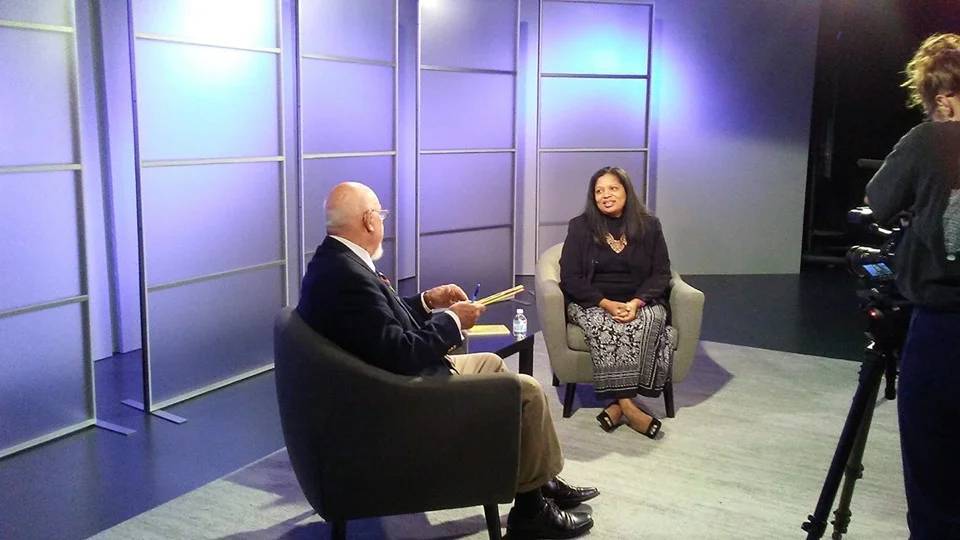
Poet Jacqueline Trimble speaking to Don Noble on Alabama Public Television.

Poet Jacqueline Trimble speaking to Don Noble on Alabama Public Television.


A snapshot of happenings

After growing beneath the wing of AWC, the MAGIC CITY POETRY FESTIVAL stretched into its own and became a 501c3 nonprofit this year. We are thrilled that this celebration of Birmingham poets has become a permanent fixture of Alabama’s literary landscape thanks to the vision and persistence of its Executive Director, Ashley M. Jones.

SUE BRANNAN WALKER’S fascinating poetry collection, Let Us Imagine Her Name, earns a thoughtful review from Frederick W. Bassett.

Two of MYSTI MILWEE’s English poems "Waiting for a Lovely Soul" and "The Path of Life" were translated into Hindi and published in the newspaper News Folder in New Delhi, India.

The first recipient of AWC’s Jane Rascoe Honorary Membership Fellow (sponsored by her spouse Wayne Rascoe) was awarded to Birmingham poet, JESSICA SMITH. Soon after this award, Jessica Smith went on to win the 2019 Betty Jane Abrahams Memorial Prize from the Academy of American Poets for her poem, “Daybooks May 3 2013”. We are so proud of this poet.

BOB MCCOUGH’S “Books, Beards, Booze” podcast is available for free streaming online. A great source for Alabama’s steampunk literature community.

Poet JACQUELINE TRIMBLE is writing for the first South African online soap opera in Afrikaans. Theshow, Die Testament, airs on September 2, and American Happiness, Jackie’s collection of poetry, is as poignant as it is lyrical.

ADAM DAVIS continues to combine faith and hope in his devotionals, this time partnering with the one and only Lt. Colonel David Grossman to make Bulletproof Marriage, a devotional for the times.

In the works

Next week, the newly-formed AWC Committee for Education will be meeting at Claire Datnow’s home in Hoover to begin planning a series of free writing workshops that enable local writers to share their skills with the community.

As for what’s coming….. is it too much to say everything? Not to mention the availability of the Awarded Writers Collection in print and ready for online purchase.

Take a peek at the Calendar or visit the AWC Facebook Page to catch up on what’s coming soon.

unnamed.jpg


Guest User
AWC and AWF: Partners in Alabama's Literary Community
safe_image.php.jpeg

AWC Helps Alabama Writers’ Forum Celebrate Its 25 Years of Programming by Partnering to Sponsor Youth Writing Workshop


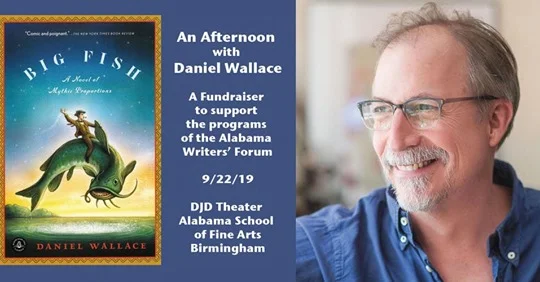
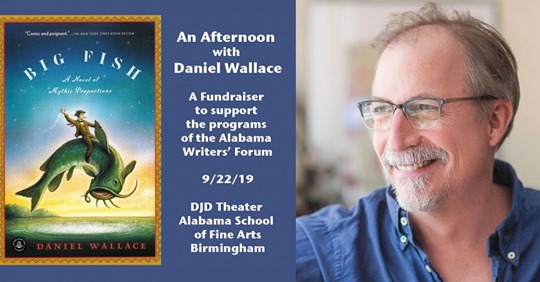
The AWC board is pleased to announce its support of the Alabama Writers’ Forum’s 25thAnniversary celebration, which will take place at the Alabama School of Fine Arts in downtown Birmingham on Sunday, September 22.

The AWC will be a sponsoring patron of the event, with its financial support ($500) underwriting a youth writing workshop led by the day’s featured guest, bestselling novelist and 2019 Harper Lee Award-winner Daniel Wallace.

Following the workshop, which will benefit students from the Alabama School of Fine Arts and several other schools in Jefferson County and the city of Birmingham, Wallace will give a public reading of his work in the Dorothy Jemison Day Theater on the ASFA campus starting at 2 p.m.

Tickets for the 2 p.m. reading are available to AWC members at the Forum’s member rate of $30; two lucky AWC members will receive VIP tickets by drawing. VIP tickets include premium seating and a signed limited edition print of a Daniel Wallace original drawing.

All proceeds go to supporting the Forum’s much-needed literary arts programming, including its Writing Our Stories program, which brings high-quality, year-long creative writing instruction to Alabama schools and juvenile justice facilities where such creative opportunities would otherwise be unavailable.

To purchase tickets, visit Eventbrite at https://bit.ly/30NSRqZ.

No purchase is necessary to enter the AWC drawing for VIP tickets; simply email AWC board member TJ Beitelman at tjbeitelman@asfa.k12.al.us to enter.   

Guest User
2019 AWC Conference Faculty: Meet Alabama playwright, C. Stefan Morrisette.
Chase Morrisette.jpeg

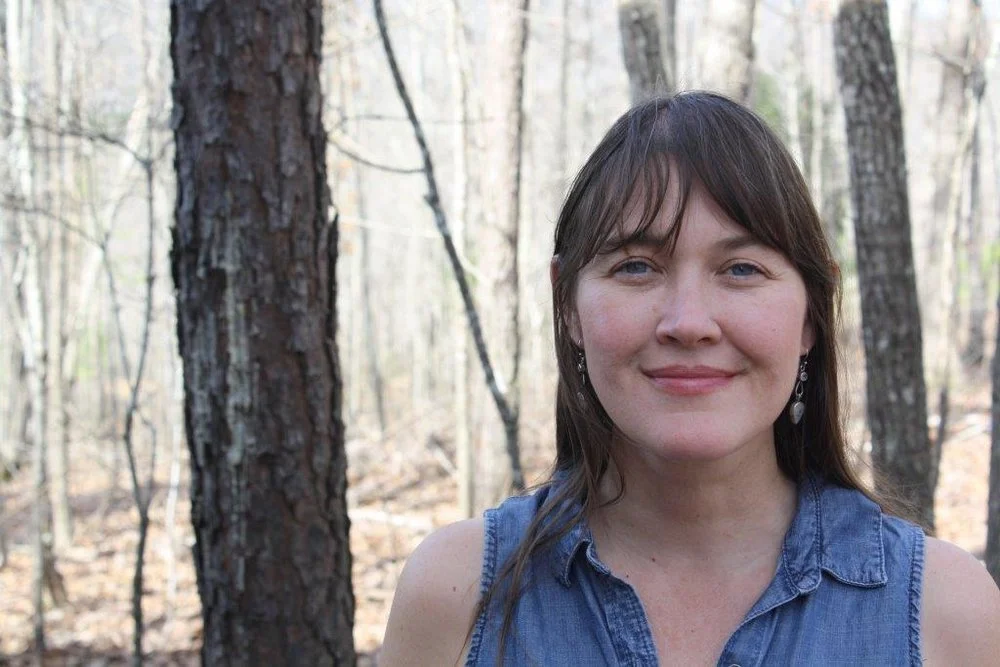
Chase Stefan Morrisette (playwright) was raised in Elberta, AL, where he spent most of his childhood using his imagination to form stories and create characters. From there, he developed an interest for live theatre – the act of becoming characters / storytellers. 

After graduating high school, Morrisette moved to New York attending The American Musical and Dramatic Academy, receiving his training in musical theatre. He continued his theatrical career focusing on costume design and set design, taking internships in costume houses and later designing for Off-Broadway before his focus went back to his writing. 

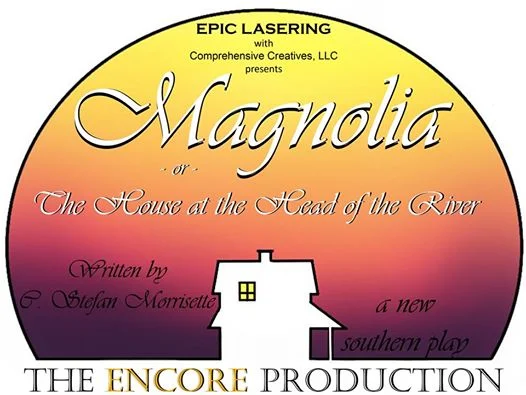
In late 2009 / early 2010 he began working on the first draft of what would later become Magnolia or The House at the Head of the River after being inspired by a trip down the Magnolia River in Magnolia Springs, AL, and classic southern dramas such as Fried Green Tomatoes and The Devine Secrets of the Ya-Ya Sisterhood. The play, Magnolia, made its world premiere in March 2019 and enjoyed an encore production in July. 

Morrisette later collaborated on libretto for the indie musical The Journey: The Story of Your Life. The Journey had its initial reading in Gulf Shores, AL, before being performed in Boca Raton and Miami, FL, and participating in the New Orleans’ Fringe Festival before being workshopped in New York. His other works include Places!, a new backstage comedy, and The Misadventure of Tanko Mankie. Places! had its first staged reading in May 2018 at South Baldwin Community Theatre and will have its premiere January 2020.

You can learn from Chase Stefan Morissette’s experience and talent at the AWC Annual Conference in November 2019, where he will offer a workshop on playwriting at 8:00 am on Saturday morning.

Guest User
Blood and Breath: Tina Mozelle Braziel's "Known By Salt".
Image source: Green Bucket Press

Image source: Green Bucket Press

by Lana K. Austin

WARNING: I’m a subjective reviewer. Not because I know and like Tina Mozelle Braziel, though, yes, I do know and like her. But she is a relatively new friend, so that’s not the basis of my bias. I’m inherently subjective because the poems in Known by Salt thrum inside me with a pulsing sense of truth that make them seem as if I have lived every single one of the stories conveyed. And this truth is, despite the sometimes difficult nature of it, intensely beautiful. Compellingly beautiful. This is the kind of truth that, like the salt that becomes one of the motifs in the book, not only flavors things, but is as necessary an element in our lives as blood, as breath. With such necessary truth coursing through it, Known by Salt will make every reader feel subjective, feel as if the book speaks directly to them, and no greater compliment can be given to a book.

But how does Braziel accomplish this? One way is through imagistic prowess, not just that she wields words so deftly, but that she sees so clearly. There are things that everyone else might walk right past and view as ordinary (a trailer, a house under construction, objects in the natural world), but Braziel relishes them, picks them up in her hand (or in her mind, or in her heart, or usually in all three concurrently), and turns them over and over and as she peers deeply into their every crevice to see each hidden facet. She then describes what she sees magnificently.  She bears witness with words.

Many of the things Braziel sees “talk to each other.” Themes emerge. Repeated motifs snake their way through the entire book like the bodies of water that populate the poems, motifs we hear sung again and again, familiar tunes we long to sing repeatedly like all great songs: salt, water, nature, the body.

From the first poem we can immediately ascertain that as we sojourn with Braziel we’re going to see things anew. The trailers, like those described in later poems, mentioned in “Homemaking Along Lay Lake” proffer loveliness beyond the banal Jerry Springer cliché, and, dare I say, they provide epiphany, with their “dahlia bulbs” that “need to be dug and spread”, and “cucumber and squash/that bridge well beyond their beds,” “throng of willow flies”  and “drift of blossoms.”

And the water. Oh, the water that ebbs and flows and rises and recedes and rises again in Known by Salt. In “On Lay Lake,” Braziel summons us back to the beginning of everything, beckons us to sing a primal song, to crawl back into the womb with, “Like a daughter who has not forgotten/ the world of her mother’s body, I know this lake, the springs/ veining her with cold, each splash/ an attempt to get outside herself.”

Then there is the body. A body. The speaker’s body. My body. Every body. Our corporeal selves are rendered astutely in Known by Salt.  We go literally to the pores in “To Season,” with the utterly marvelous lines, “Now praise us, salt (you mineral),/ sing of grit, hum as you rise from our pores.” And the body continues to come alive in “Allure”:


  1. Suede

Nude before the mirror, she scrutinizes
her sapling legs and the ant-bite swell of breasts.

She fingers the gold sequined thong,
then steps into it the way she’d cross a low wall.

Sliding into heels, she grasps her hips.
Sashay, she thinks, sashay

like the harried Bugs Bunny sways
until Elmer Fudd goes walleyed.

The suede bra tsk-tsks shut
between her breasts.


That’s just an excerpt from that poem, but you can hear that suede bra tsk-tsk, can’t you?  You can feel your body want to sashay, too, can’t you?

There is most certainly a kind of culmination of themes towards the end of the book where we see all that’s come before coalesce. The salt, the body, the water, all of it either directly referenced or implied, all the motifs of Known by Salt, are humming in every poem in the final section, but especially in those that feature building a house, building a home, building a heart, for surely it’s all three magically blending. The “Rivering” described is very much alive and necessary like all of Braziel’s poems… necessary like blood, like breath:

Rivering

When you say you will build me a river,
you sink a shovel and level planks.

I know you, your apron of nails,
the drill bits you leave scattered

around the house and yard.
Their ends are shaped like tiny daisies.

A river, you say, will make me happy
forever. And I think of our first day.

You spread my quilt in the sun.
I told you then it is all water:

the hill is wave; the field, a low pond
You said I see that now.

And now I know rivers.
How they gully, smooth rock

to stone, slick mud.
How they bed by lying down.


Source: WBRC 6

Source: WBRC 6

Explore more of Tina’s poetry (as well as that of her salt sister Ashley M. Jones) in this excellent interview by WBRC.

Guest User
The July Shortlist: 10 Ways to Improve Your Fiction
1*rqUxxkh1FfDYrmfVDz-wVg.jpeg

A new series in which every month brings ten articles by notable writers with tips on craft, style, and trade.

This month we will focus on how to improve your fiction — whether through revision, diction, narrative arc, or language. Our gratitude to the incredible literary journals where these pieces were originally published, including The Millions, The Smart SetOpen Letters Monthly3 A.M. Magazine, Asian-American Writer’s Workshop, Necessary FictionThe Short FormThe Paris Review, The Guardian, and Writer’s Digest.

1. Kelly Cherry on diction.

Another of the things you can do that will energize your story or poem is to pay attention to your diction. Diction simply means the words you choose. You don’t want to pull up some ridiculously outdated or seldom-encountered peculiar word, but there are heaps and heaps of synonyms for almost everything. Pick a word that suits the rhythm, that is a surprise but not so far off course that no one knows what it means, that harmonizes with the other words in your story or poem. All the times I’ve told you that if you do this or that, readers with run away? Well, choose the right word and those readers will hang on your skirts (or jeans) as if they were your own children. And in a way they are, for they are enthralled by what you have to say in those words that are like dessert. Your readers’ eyes grow wide, your readers lean in to hear you better, and, word by word, the story writes itself.

No, I’m not taking back anything I’ve said about how much work goes into a story or poem. For the most part, you must write the piece. But there will be times when you feel as if a muse is putting words in your mouth. Sometimes you’ll begin writing from a voice you have not consciously selected. That’s okay. Follow that voice. In fact, there will be times when you will feel you no longer exist. And that’s the best reason of all for writing. That’s the mysterious part, the part that takes care of itself. We might also call it the subconscious.

1*ZuYhmqqZs1lYPKC_3WkB5g.png

Image source: The Flying Comma

2. Edan Lepucki on broadening the narrative arc in short fiction.

In my classes, I love to teach John Gardner’s“foreplay paragraph,” which is what he calls a paragraph that precedes a big reveal–like that of a dead body. In this kind of paragraph, the writer has to signal to the reader that something big is up ahead, while still making the prose good enough that the reader won’t want to skip over it. In this exercise, Gardener is tipping his hat to the way language itself evolves in a narrative: to signal, reflect or incite change. Next time you’re writing, consider if your piece records any kind of aesthetic change. Does the language start lyrical and move toward something more minimal? Does the voice go from barbed to vulnerable and back again? If you want, you can isolate a paragraph, and consider how it moves, how it affects the reader, how it reveals character, setting or conflict, as it progresses. Sometimes arc is best understood when considered on the smallest level.

3. Gary Lutz on how to increase sentence acoustics and establish “the poetry of the paragraph.”

Unobtrusive assonance is one of the ways in which a writer can unite the words of a sentence so that the relations between words are not simply grammatical and syntactical but also acoustical as well. Furthermore, when a writer is searching for a word to fill a vacant slot in a sentence, the writer can look to the other prominent words in the sentence, examine their sonic disposition, and borrow something of their sound: this can lead the writer to a word that might not otherwise occur to him or her.

4. Matt Salesses offers more than 57 “moves in contemporary flash fiction,” including these:

50. Negative desire

51. Ending evoking beginning and middle

(“For sale. Baby shoes. Never worn.” — Hemingway)

52. Information/backstory given in only one line of the story

53. Character becomes circumstance

(See “For the Birds,” by Mark Budman, in which a characters starts to feel like the bird stuck in her wall.)

54. Pushy secondary characters who force action from primary characters

55. Symbolic white space

(For example, the space break in Hempel’s “San Francisco” as a spacial representation of an earthquake)

5. Kelly Cherry’s instructions on how to “revise until you drop.”

When you revise, you subject yourself to new understandings of what you are writing. You are, remember, creating a world, whether it is an enormous world or a very small one, a midget. You want to be able to see it as clearly as you see Venus in the early evening sky. Proportion, information, dialogue, description, narrative, sentences, lines, words — all these are foundational to your work.

If you were to change your first-person piece to second- or third-person, would it work better? If you were to change the past tense to the present tense or even the future tense (I have a future-tense story titled Her Life to Come; poet Billy Collins christened it “the prophetic imperative”), would it work better?

If you were to write it from a dog’s point of view — a suggestion from Antonya Nelson, novelist and short-story writer — would it work better? (In fact, it is not all that unusual to write from a dog’s point of view. Dogs are smart, feelingful, and observant of humans.)

6. Robert Kloss and various other writers spill their revision secrets.

My writing process doesn’t really make a distinction between “writing” and “revision.” To me, revision is writing and writing is revision. I tend to begin any work with longhand sketches of paragraphs, almost a semi-outline of interesting events and observations and phrases that should take place, and when I type those sketches into the computer I also expand them, flesh them out, and hopefully improve the writing. And while that process continues I also print out the pages to that point. And I carry those printed pages with my notebooks and pens, and to those printed pages I continue to add and cut and improve the prose, and when I type new sketches into the machine I also input my changes to the typed manuscript. So the finishing of one draft is really the culmination of five or six overlapping stages of composition and revision. And the morning after one “draft” is finished I begin the second “draft” by printing out the first and, again, carrying around the pages with notepads and pens, adding and changing and sketching new paragraphs. After a certain point there are fewer paragraphs needed to add, fewer that need crossing out, and something like a story or a novel rounds into shape. Somewhere in this process there is typically some period of research, and I tend to sit with my heaps of pages and pens and notepads with books opened before me, jotting more notes, developing more paragraphs. I have recently begun experimenting with stopping work after each draft, as is recommended by many. I can see some benefits to this — for one, it allows the subconscious to work out problems, to come up with new inventions, to heal from the constant trauma. But there is something also to be said for the feverish momentum of the continuous process.

1*WGdlHnMOqsyyfD5ey7LcMA.jpeg

Image source: The Paris Review and Peter Mendelsund

7. Peter Mendelsund on what we see when we read.

Literary characters are physically vague — they have only a few features, and these features hardly seem to matter — or, rather, these features matter only in that they help to refine a character’s meaning. Character description is a kind of circumscription. A character’s features help to delineate their boundaries — but these features don’t help us truly picture a person.

* * *

It is precisely what the text does not elucidate that becomes an invitation to our imaginations. So I ask myself: Is it that we imagine the most, or the most vividly, when an author is at his most elliptical or withholding?

(In music, notes and chords define ideas, but so do rests.)

8. George Saunders on “revising up” your reader.

We often think that the empathetic function in fiction is accomplished via the writer’s relation to his characters, but it’s also accomplished via the writer’s relation to his reader. You make a rarefied place (rarefied in language, in form; perfected in many inarticulable beauties — the way two scenes abut; a certain formal device that self-escalates; the perfect place at which a chapter cuts off); and then welcome the reader in. She can’t believe that you believe in her that much; that you are so confident that the subtle nuances of the place will speak to her; she is flattered. And they do speak to her. This mode of revision, then, is ultimately about imagining that your reader is as humane, bright, witty, experienced and well intentioned as you, and that, to communicate intimately with her, you have to maintain the state, through revision, of generously imagining her. You revise your reader up, in your imagination, with every pass. You keep saying to yourself: “No, she’s smarter than that. Don’t dishonour her with that lazy prose or that easy notion.”

And in revising your reader up, you revise yourself up too.

9. Gary Lutz’s classic essay on how syngery between words in a sentence keeps the mind engaged.

Once the words begin to settle into their circumstance in a sentence and decide to make the most of their predicament, they look around and take notice of their neighbors. They seek out affinities, they adapt to each other, they begin to make adjustments in their appearance to try to blend in with each other better and enhance any resemblance. Pretty soon in the writer’s eyes the words in the sentence are all vibrating and destabilizing themselves: no longer solid and immutable, they start to flutter this way and that in playful receptivity, taking into themselves parts of neighboring words, or shedding parts of themselves into the gutter of the page or screen; and in this process of intimate mutation and transformation, the words swap alphabetary vitals and viscera, tiny bits and dabs of their languagey inner and outer natures; the words intermingle and blend and smear and recompose themselves. They begin to take on a similar typographical physique. The phrasing now feels literally all of a piece. The lonely space of the sentence feels colonized. There’s a sumptuousness, a roundedness, a dimensionality to what has emerged. The sentence feels filled in from end to end; there are no vacant segments along its length, no pockets of unperforming or underperforming verbal matter. The words of the sentence have in fact formed a united community.

10. Adrienne Crezo on why you should write the unlikable character.

…….a character who sets himself up for conflict and consequences through the dastardliness of his doing — is surely unlikable, yes, but also magnetic. You want to watch him ruin his life. He repulses you in the same way a car accident is simultaneously disturbing and hard to look away from. This character is a train wreck, and it is glorious to behold. Every time he does something unwholesome, immoral, felonious or just, like, super-rude, he creates a conflict. The anticipation and delivery of that consequence is deeply satisfying for a reader, and by their very nature, not-nice characters create these conflicts almost constantly. In the words of Oscar Wilde, “The suspense is terrible; I hope it will last.”

Guest User
Apply for the Desert Island Supply Co. Fellowship!
desert island suuply co.png

The Desert Island Supply Co. is accepting applications for Fellows who will contribute to DISCO’s mission and operations during the 2019-20 academic year.  

The Desert Island Supply Co. is a nonprofit creative writing and arts center for students aged 6 to 18 in Birmingham. Our mission is to work alongside students as they develop  the creative tools they need to explore and document their worlds.

We lead weekly workshops in schools, and we offer after-school programs that are free for all kids in the Birmingham area. Our explorer-themed headquarters in Woodlawn also serves as a hub for creative community projects and events.


Fellowship Overview

We are looking for undergrad/graduate/recently graduated students who are passionate about creative arts, education, and design. Fellows assist in our in-school and after-school workshops, support the day-to-day administrative functions of the organization, and help to host readings and events at our space in Woodlawn during the semester. Fellows gain valuable experience in a dynamic teaching environment and see the inner workings of a growing nonprofit.


General requirements

  • Commitment to a set schedule of at least 6 hours a week

  • Enthusiasm for literature and creative arts

  • Excellent written and verbal communication skills

  • Attention to detail and high level of organization

  • Experience working with children is desirable

  • Completion of Fellowship Project that brings students and/or community members together in creative ways

Fellowship Benefits

  • End-of-semester stipend

  • Learn how nonprofit organizations work

  • Develop public speaking and presentational skills

  • Foster meaningful relationships with students and coworkers

  • Work with creative people at one of Birmingham’s best nonprofit organizations

  • Get experience in program planning, product design, and retail

  • Fellowship hours may be eligible for class credit


Interested applicants should send a cover letter, resume and the contact info for two references by Friday, May 18.


Brian Connell

Executive Director

Desert Island Supply Co.

brian@desertislandsupplyco.com


Guest User
The Little Nature Trail That Keeps On Giving: Thoughts from Claire Datnow

We are proud to feature a member column from AWC writer and media maven, Claire Datnow who shares her thoughts about the work being done to restore the nature trail and outdoor classroom she created with students back in the 1990s.

Claire is thrilled that the trail is being restored. She notes that this first ecology class became the inspiration for her eco-mystery series The Adventures of the Sizzling Six. Star Bright Books has acquired the series and will be republishing it, beginning with Monarch Mysteries this fall.

Also, don’t miss this “At This Alabama School, the Birds Belong to Everyone” by Katherine Webb-Henn, which offers more visuals as well as the video shared below.


“The Little Nature Trail That Keeps on Giving” by Claire Datnow

On this chilly winter morning, I get the odd sensation that I’ve entered a time warp. No, I am not in The Rocky Horror Show. I’m on the grounds of W. E. Putnam Middle School with a trash bag and clippers in hand. You see, way back in the 1990s my dedicated middle school students and I began building a nature trail and outdoor classroom. We never imagined that two decades later it would be blossoming anew.

Under the auspices Principal Terrell Brown, Ansel Payne, executive director of the Birmingham Audubon Society, and the Jones Valley Teaching Farm the trail is being cleared of invasive Chinese private to create a nature sanctuary for Brown nut hatches, and a place for teachers to integrate nature into the curriculum for all students.

Janina Metro, my student in the Gifted and Talented program at Putnam between 1998-2000, penned this letter to me:

I remember when we started working on the Panther Paw Nature Trail. At first, I was excited to get out of the school building for any reason, but soon fell in love with being in the woods and learning about the plants and animals that we saw. I remember the invasive species Mrs. Datnow pointed out . . .. This was my first introduction to the importance of native plant species on the continuing existence of native wildlife …Even now, as I hike and backpack with my own four children, I think fondly of the time as I point out the mayapple, trillium, the liverwort, and other plants . . . I often walked over to the trail with my best friend, who was part of the project, after school and on weekends . . . It was a wonderful place . . . to be free of our troubles and worries. The peace we found there has inspired me to teach my children about our world and how to preserve what we have been given, and to become wise stewards of nature.

The restoration project, slated to continue next fall, comes at a time when Birmingham activists are spearheading a new era of environmental justice to address decades of racial disparities and offer a better vision for the city’s youth.

I am thrilled to see this trail and the school grounds taking shape, and to be a small part of this exciting outreach.

Claire at Putnam Work Day Reminiscing over the Scrapbook Documenting the Opening of the Panther Paw Nature Trail

Claire at Putnam Work Day Reminiscing over the Scrapbook Documenting the Opening of the Panther Paw Nature Trail

Claire with Gayle Flowers (former Putnam teacher) and Mayor Randall Woodfin (former Putnam student)

Claire with Gayle Flowers (former Putnam teacher) and Mayor Randall Woodfin (former Putnam student)

Claire’s Eco-fiction for middle schoolers provides a counter-narrative in which girl heroines are driven by eco-fascination and the desire to preserve something they love.
— Alina Stefanescu, Claire's avid fan

Claire Datnow is the author of a series of eco-mysteries for 4-8 graders, The Adventures of The Sizzling Six, which reflects her passion and awe for the natural world. She wanted me to mention the wonderful way in which AWC impacted her life by connecting us.

After attending Claire’s workshop on “Eco-Fiction” at AWC, I was inspired to share her writing with my students and family in Tuscaloosa. Claire came and spoke to my middle school class at the Tuscaloosa Magnet School, and I was thrilled to offer each student their own copy of Claire’s eco-mysteries. At the time, I was blogging about the state, and Claire was thrilled when I shared her amazing educational resources with others.

Guest User
A conversation with David Hornbuckle about Alabama meteors and his new novel.
52567692_2572879512738801_7480556389257969664_n.jpg

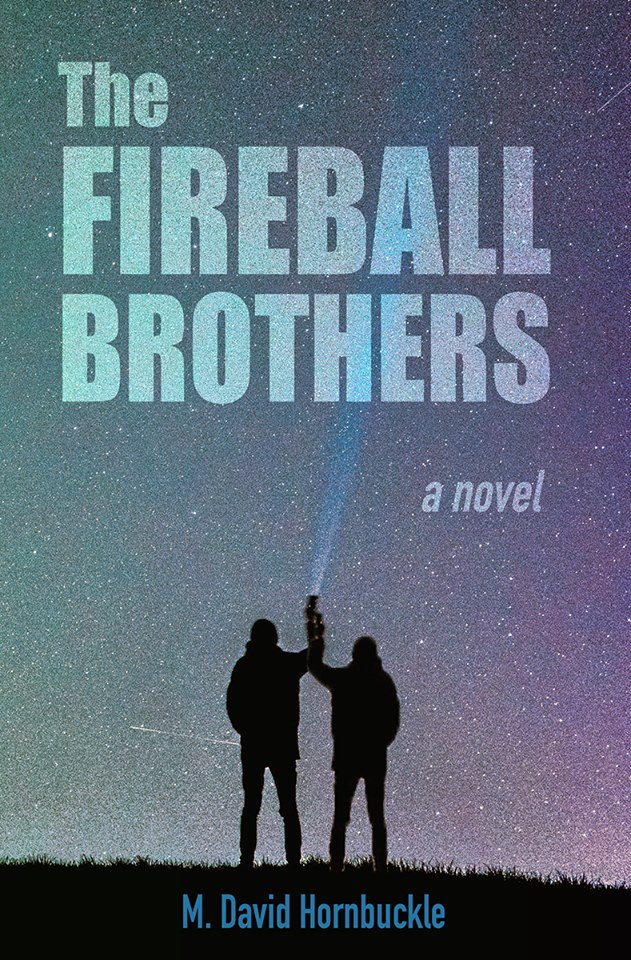
A synopsis of The Fireball Brothers by David Hornbuckle, published by AWC’s beloved Livingston Press:

In 1959, two teenage brothers in rural Alabama are swimming in a pond when a fireball falls from the sky and lands in the water near them. When they come out, they are fused together, but nobody can figure out the cause. A doctor in New Orleans claims he can help them. To raise money for the surgery, they travel throughout the Southeast playing music. A wily reporter from Tupelo named Munford Coldwater follows their story as they meet snake oil salesmen and carnival barkers who try to take advantage of them. Filled with atmospheric music and setting, this novel mixes love, family, race, and political intrigue.


AS: Welcome David. Let’s talk about the synergy between local history and fiction. You mention that part of the story is rooted in the experience of Billy Field, a beloved Tuscaloosa film-maker. How did you work that into the story? 

DH: I learned about the Sylacauga meteorite after I'd already written a good chunk of the book. Here I was writing a story about a fireball that falls out of the sky and changes the lives of this family, and I find out that a woman in Sylacauga named Ann Hodges was actually struck by a meteorite just a few years before the time when my story takes place. She is actually the only person to be physically hit by an object falling from space, and it happened in Alabama. It seemed like I couldn't really tell the story without at least acknowledging it.

I talked to Billy when I found out he'd made a documentary about the incident in Sylacauga However, that's HIS story, so I didn't work it into my book as much as I could have. He actually has a copywrite (or whatever the proper legal term for ownership of this sort of thing is) on the story of the family that happened to. In the final draft, I actually removed a couple of references to the Hodges meteorite incident because I didn't want to overstep my bounds there. 


AS: Would you consider this to be a science fiction book?

DH: That wasn't my intention, but if people like sci-fi, they might like it. Some of the earliest books I read were by authors like Ray Bradbury, but as a teenager I became interested in writers who use elements of sci-fi in the service of something... else. Kurt Vonnegut comes to mind, or even some of Thomas Pynchon's work. I like what writers like Kelly Link are doing in bringing elements of fantasy and fairy tale in to stories that don't fit easily into a genre. And I guess that's what I was trying to do in this book--using elements of sci-fi and fantasy in a book that is really just about people, which to my mind is more of what gets called "literary fiction."

To the extent that this story is sci-fi, I think it comes more from my sense of surrealism than any real intention to do the kinds of things that science fiction often tries to do (i.e. warn/predict about dystopian futures, etc -- not that it's limited to that). Space ships and werewolves are my melting clocks.


AS. This is your first book in ten years. How does it relate to what you've done in the past, if at all?

DH: My previous full-length novel--Zen, Mississippi--also deals with issues of Southern identity. Fireball plays around with the idea of "space" and all the various ways that we use that word, and Zen, MS does something similar with the idea of time. So, in a way, this is my Time/Space series.

Munford Coldwater is a character in both novels, but Zen, MS is contemporary, so the character is older. Fireball takes place in 1959 when Munford is much younger.

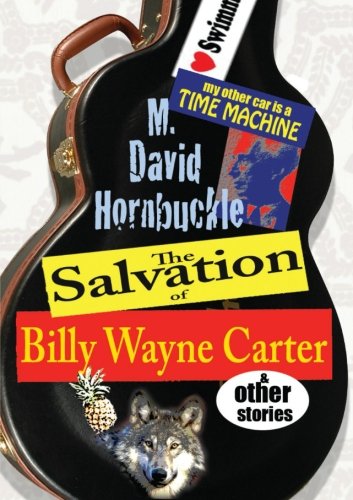
My novella, The Salvation of Billy Wayne Carter, is about a second Civil War that is fought more on cultural grounds than political. The war is over things like what music you should listen to. In a way, it's a meditation on the concept of post-modernism and where we go from there. I wrote it when I was super young, and it shows, but there are some good parts I think.


AS. Thank you so much for taking the time to chat with me, David. In the spirit of sharing great writing on the southern scene, what three fiction stories by southern writers would you share?

DH. Tough to narrow down three short stories, but here are three recentish stories by writers I like: “Shiner” by James Braziel, “Mushroom Politique” by Adam Latham, and “When the Boys Went” by Heidi Espenscheid Nibbelink.


BOOK RELEASE PARTY INVITATION

You can catch David Hornbuckle at his book release party in Birmingham, Alabama on April 20th, 2019. There will be free fiddle music, cocktails, fiction, and the best of Alabama.


M. David Hornbuckle lives in Birmingham, Alabama where he teaches English at the local university. Over the years, his career has included journalism, technical writing, and bee farming. He is also a musician, most known for his former bands PopCanon and the M. David Hornbuckle Dixieland Space Orchestra. In addition, Hornbuckle is the founding editor of Steel Toe Review: A Journal of Southern Arts and Literature. This is his third book.

Guest User
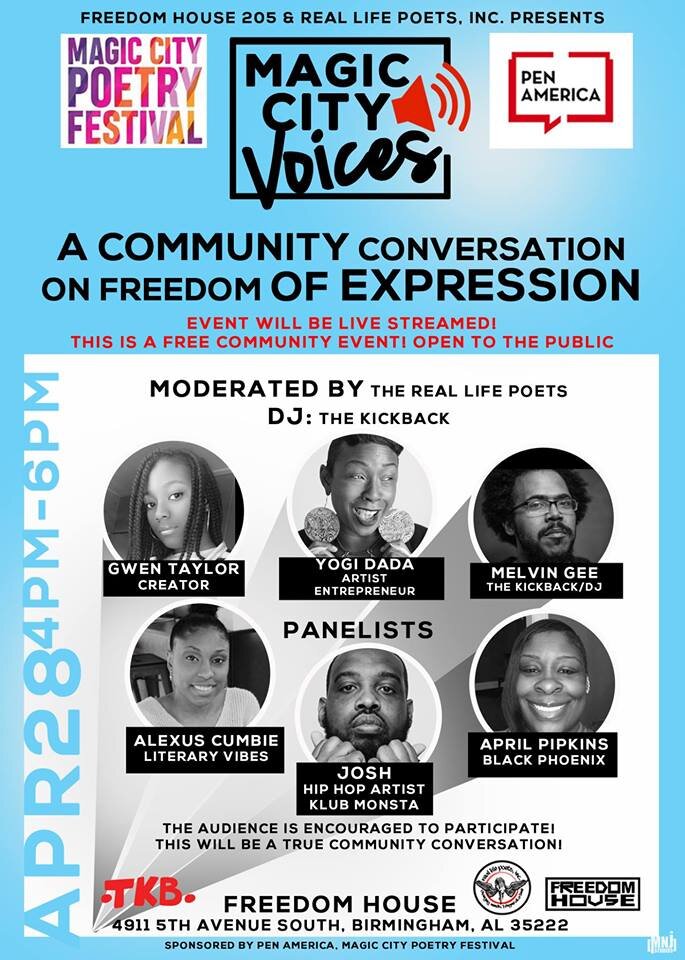
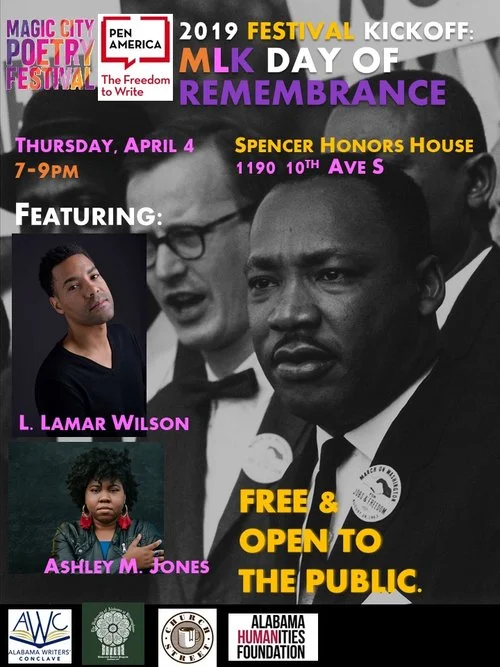
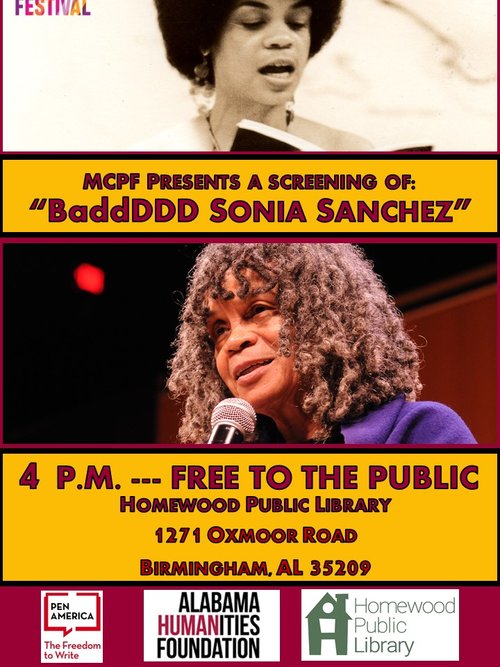
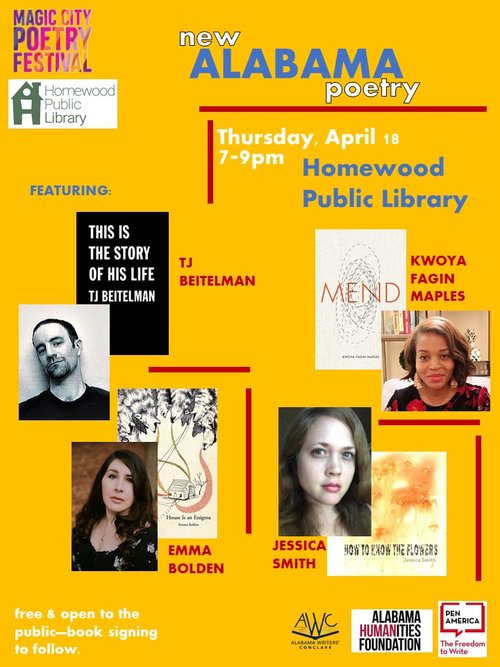
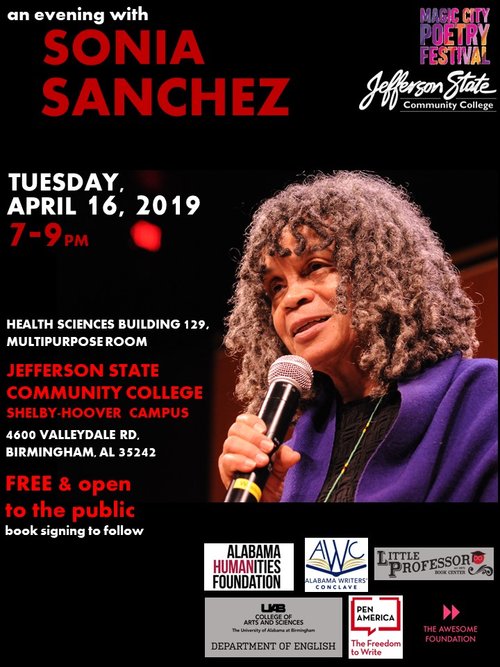
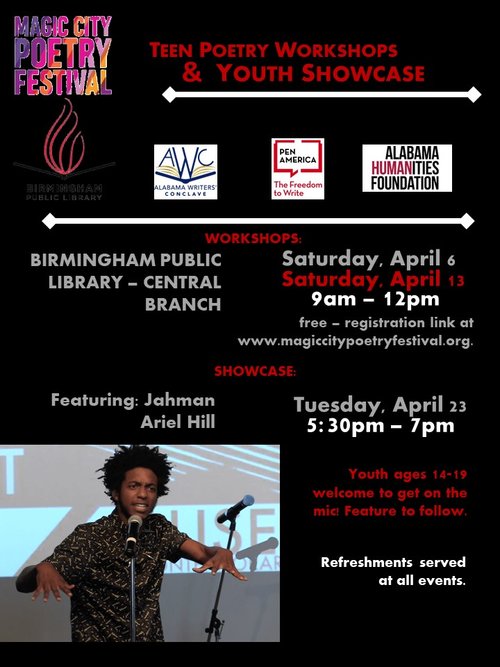
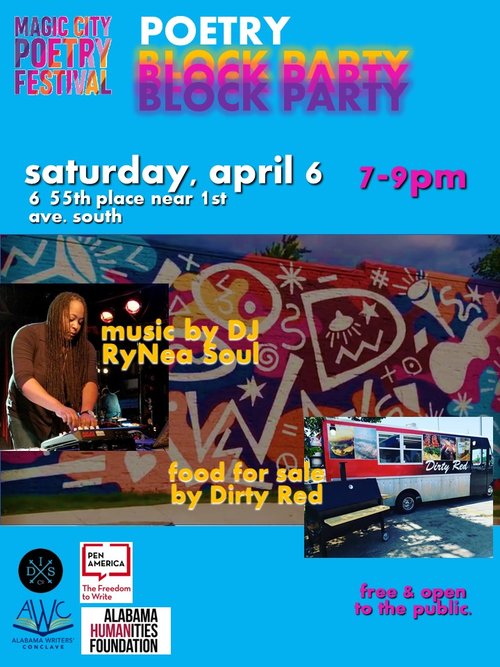
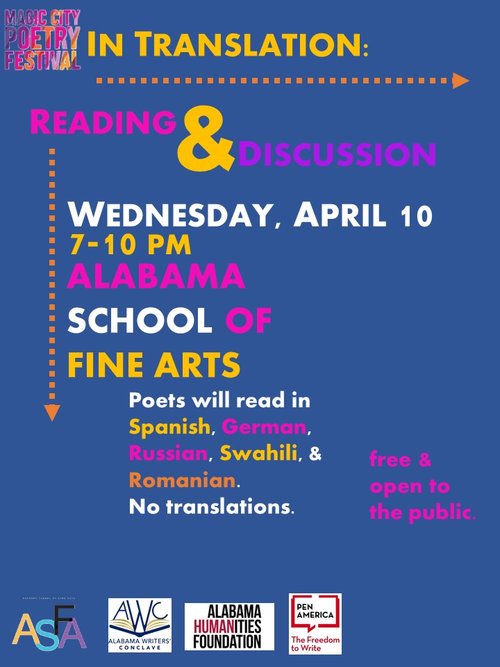
The 2nd Annual Magic City Poetry Festival starts this week.

What do you do if you have a dream of a hosting a poetry festival in your hometown? If you’re Birmingham poet Ashley M. Jones, you make it happen.

AWC is proud to partner with Magic City Poetry Festival in support of the second annual poetry festival that celebrates poetry, art, and community in Birmingham, Alabama.

Birmingham’s magic is not the province of a few but the creation of many artists, writers, educators, nonprofits, and activists. Over the coming month, Alina Stefanescu will spotlight Birmingham poets and community partners in a series of “Love Letters”. You can read about MCPF’s love for DISCO, Church Street Coffee, and Real Life Poets and Freedom House.

Mark your calendars for the following events (and get details from the website):

AND SO MUCH MORE!


Take a minute to explore the sponsors on the website and share with your friends. Or read the press release. And be part of this fabulous event that was incubated in by AWC Board Members.

Guest User