newsback.jpg

Blog

What’s happening in the Alabama writing world…


Posts by Date
Posts By Category
 
 
Brent Stauffer reviews Ghostly Demarcations by Joe Taylor.

What follows is one AWC member sharing their thoughts on a new book by another AWC member. We are grateful to Brent Stauffer for his close reading of this short fiction collection by Joe Taylor (Sagging Meniscus Press (June 1, 2019).

“Unabashedly conventional horror tales with an understated but remarkable lead character.,” says Kirkus Reviews.

Joe Taylor’s story collection Ghostly Demarcations is a meditation on friendship, growing up in the South and the nature of haunting. Taylor’s voice rings true, with a lyricism woven from homespun cloth, shot through with threads of otherworldly gold. Only the fantastical elements of wraiths, poltergeists and the like remind you that perhaps this isn’t, strictly speaking, a memoir.

We first meet our unnamed hero at ten years old, in rural Kentucky, as his best friend Galen describes his recent ghost sighting. (The book is, in part, dedicated to a person named Galen. Maybe these stories are more true than an adult brain can comfortably fathom!) Their unbreakable bond is a main fixture around which all the events described, spooky or otherwise, revolve.  This is true even when the arcs of their lives have bent away from each other. In “Angel’s Wings,” where Galen is in the Navy, worlds away, he is yet heard by his friend in a time of great need via a rinky dink homemade radio. Not only does Galen figure prominently in every story of the collection, he usually appears in the first page, if not the opening sentence itself. In “Faithful Companion,” which takes place during his days at the University of Kentucky, the narrator remarks, “Ha! Let UK’s atomic clock click it’s loudest: what care I, with such a faithful companion close by?”

   Another near constant element of these tales is a wry humor, sometimes self deprecating, other times displayed with postmodern flair. Taylor teases us a couple times with the nameless nature of our protagonist:  in “I Am the Egg” elderly, clueless  Mister Howard rifles off a list of incorrect monikers. (We get a good sense of what his name isn’t!) In “The Perfect Ghost Story, Plus One,” when a girl introduces herself by name, our hero tries to reciprocate only to be rudely interrupted!

Underneath the humor and homespun texture of these stories, however, lurks the   constant threat of an incursion of the supernatural. Time after time, Taylor regales the reader with a charming tale of growing up in the New South; and when a comfortable mood is firmly established, the bottom drops out with the arrival of something that is Not of This World. More than once a reader might have to go back over a passage for a missed clue, only to find that the abruptness of the shift is, indeed seamless. After continuing to encounter these transformations, one develops a slight tickle in the back of the brain as the story unfolds in stately fashion. The anticipation, subconscious or not, of a surreal explosion creates a pleasing background tension that keeps the reader awake and engaged. 

The combinations of real and unreal, humorous and poignant, full fledged characters and well crafted master storyline, create, in Ghostly Demarcations, an overall delight. The exploration of friendship over time is laid across the known and unknown, in particular, quite naturally, the mysterious dynamics between Life and Death. The reader is left with a profound sense that life, with all its unexpectedness  and certainty of a tragic end, is well worth the living.

Guest User
Get to know AWC Board Historian, Clarence Bonner.
0.png

Dean Bonner was born and raised in rural Georgia but can claim naturalized citizenship in Tallapoosa County, Alabama and Virginia Beach, Virginia. As a retired Coast Guard veteran. Bonner left the tarpaper shacks of Appalachia for a long military career, rising through the enlisted and officer ranks. He was a skilled Morse telegrapher and a calming voice during many search and rescue cases. He left a town of 300 souls to travel the world, living in Boston, New Orleans, DC, and even on the island of Guam for a couple of years. 

During his 30 year Coast Guard career, he earned his BS in Security Management and still maintains the highest international certification in Security Management, Certified Protection Professional.  He served his final eight years of active duty as an Intelligence Officer. 

Dean is a skilled Studebaker car mechanic, tube radio repairman, firefighter, and a weekend gold prospector.  His upcoming projects include recording two albums of his original humor and writing a new compilation of short stories. His wife Patricia, a multi-talented artist, shares these same interests. Together, they travel and spend time at homes in Alabama and Virginia.

Dean was a weekly columnist for The Dadeville Record before he began work as a freelance writer for Lake Magazine and Lake Martin Living magazine. His favorite assignment to date was exploring the Hog Mountain gold mine where his grandfather and great-grandfather worked. 


His poetry is published in two collections called The Breaking and A Stormy Beginning, by Scars Publications.  His work was featured in the February 2016 issue of Down in the Dirt literary magazine. 

He wrote feature articles for The Alexander City Outlook, Dadeville Record, Lafayette Sun, and for the arts magazine The Revelator

He was a contributing editor for Lisa Ditchkoff's book, The Girl with Caterpillar Eyebrows, about educating herself while she grew up in hiding from her father, an associate of Boston mobster Whitey Bulger.  

Dean was a 2013 winner in nonfiction in Alabama’s largest writing competition, the Alabama Literary Competition, organized by the Alabama Writers' Conclave. He competed against writers nationwide with his nonfiction short story "Seeking Asylum" about visiting his mother in the state insane asylum when he was three.  

Dean has a development contract with Los Angeles-based Council Tree Productions for a television series called Tar Nation that is based on his book I Talk Slower Than I Think.  He co-authored a television pilot screenplay with Heidi Carroll for Tar Nation that placed as a Second Rounder / quarterfinalist in the 2019 Austin Film Festival.

And now you know a little bit more about a person who donates his time and skills to serve the members of Alabama Writer’s Cooperative as historian. Be sure to reach to him if your interests (or paths) cross.

Guest User
AWC Community Writing Workshops: Beginning 2020 with a Burst of Words
Memoir Writing Workshop in Orange Beach.

Memoir Writing Workshop in Orange Beach.

One of our new programs is the AWC Community Writing Workshops, which aims to connect local Alabama writers with readers and emerging writers at the microcosmic level. What does this mean?

Well, Jessica Renee Langston and Karim Shamsi-Basha created a Memoir-Writing Workshop free and open to the public in Orange Beach. Of the workshop, Jessica said:

“Making Memories into Memoirs: How to Capture and Convey Your Stories” was fantastic. Karim Shamsi-Basha, our instructor, immediately  made everyone feel comfortable and willing to share. We got to know each other, went through several exercises including title creation, idea maps and outlines, then we delved into writing our memoirs. Many of us shared our stories and it was amazing to see the quality of work created right there in a four-hour window. Karim made writing our life stories seem manageable instead of overwhelming. And we had a lot of fun, too.

Poet Laureate Emerita Sue Walker was in attendance—and she expressed a sincere appreciation for Karim’s workshop. If you aren’t familiar with Sue, she is not only a proficient and celebrated poet but also the publisher of Negative Capability Press located in Mobile, Alabama. Take a peak at this interview she conducted with author Eugene Platt on the NCP blog.

Diane Clark shares a snippet of her life story during a memoir workshop held at the Coastal Arts Center of Orange Beach on Jan. 4.

Diane Clark shares a snippet of her life story during a memoir workshop held at the Coastal Arts Center of Orange Beach on Jan. 4.


Meanwhile, up in Hoover, Claire Datnow put together a fabulous AWC Community Workshop, “A Behind the Scenes Glimpse: Environmental Education and Literature” with an interactive look into how she creates her science-based environmental Eco Mysteries.

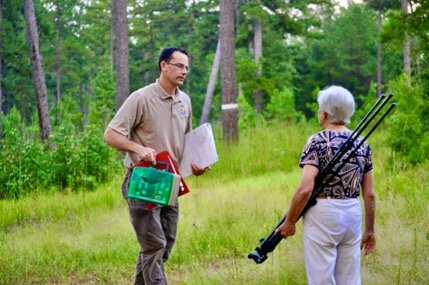
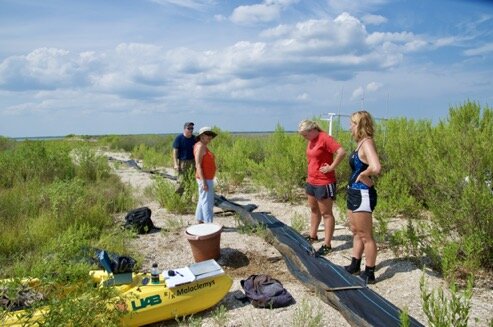
Nature lovers, writers, conservationists and adventurers in attendance explored vicarious field trips to diverse natural habits and met the dedicated conservationists who are saving Alabama’s endangered species. The adventure began with a virtual trip to Sehoy Plantation, deep in the heart of a longleaf pine plantation, where the attendees observed Eric Spadgenske with the U.S. Fish and Wildlife Service, and Mark Bailey, a conservation biologist banding Endangered red-cockaded Woodpeckers. Attendees also traveled to the Mobile-Tensaw Delta to observe the Diamondback Terrapins (Malaclemys terrapin), listed as a species of Highest Conservation Concern, where Research Biologists Ken Marion and Thane Wibbles capture breeding females in the summer, to raise them in a hatchery at UAB.

Ken Wills author of Exploring Wild Alabama and President of Moss Rock Preserve has traveled the entire state as a natural resource planner and biologist for the Alabama Environmental Council. Ken Wills outlined his successful conservation …

Ken Wills author of Exploring Wild Alabama and President of Moss Rock Preserve has traveled the entire state as a natural resource planner and biologist for the Alabama Environmental Council. Ken Wills outlined his successful conservation projects to clear invasive species at Moss Rock and Limestone Park, and replace them with native wildflowers and grasses.

We encourage you to read Claire’s blog post on this workshop and rest in the awe of it.


Vitaly Charny, lepidopterist, photographer and co-author of Butterflies of Alabama talked about his field trips over a twenty year period to document Alabama’s butterflies. This project resulted in The Alabama Butterfly Atlas.

Vitaly Charny, lepidopterist, photographer and co-author of Butterflies of Alabama talked about his field trips over a twenty year period to document Alabama’s butterflies. This project resulted in The Alabama Butterfly Atlas.

Your Turn

If you have a workshop you’d like to share with the public, please read more about our Community Writing Workshops and apply to host or develop your own. Alabama writers bring so much good into their communities and localities. We hope to support this regularly.

Guest User
The Alabama Poet Laureate Outreach Fund
Screen Shot 2020-01-07 at 6.29.50 PM.png

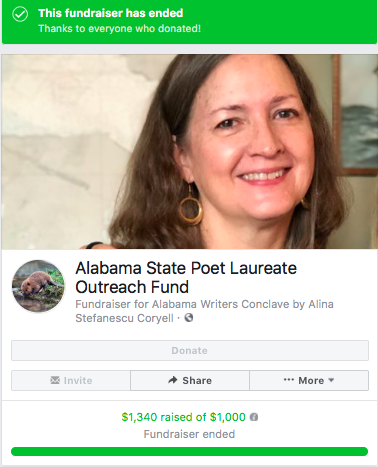
AWC was able to raise $1,340.00 for the 2020 Alabama State Poet Laureate Outreach Fund!

We are so grateful to be able to support Jennifer Horne, our state poet laureate in advocating, educating, and cultivating poetry throughout the state. 

Thank you to everyone who shared and donated. This is an example of how much her work is valued, needed, and appreciated. It should be heartening to all of us as we move into a new year of writing, editing, publishing, reading, and journeying with words.

To learn more about Jennifer Horne, visit the State Laureate page or read this conversation about her new poetry collection.

To quote the laureate, herself:

It was such an honor to be named state poet laureate, and I went into it with the general goals of connecting poets to each other and to their communities, amplifying what was going on in the literary community, and encouraging people in Alabama to learn more about and enjoy poetry while creating literary resources and events in their own towns.

When I look at my calendar over the past two years, I can see what a rich journey it's been already (with two still to go). Predictably, I've spoken at writing conferences, done workshops and readings, and been part of a number of literary events such as the One Million Poets event. I've also spoken to a Rotary Club, judged the statewide Poetry Out Loud contest for high school students and several out-of-state contests, helped plan the state book festival, Skyped with a junior high creative writing club in Los Angeles, spoken to an OLLI group about Alabama Writers Hall of Fame inductees, appeared on a panel of poet laureates with the Mississippi (Beth Ann Fennelly) and Louisiana (Jack Bedell) laureates at the Tennessee Williams/New Orleans Literary Festival, spoken at several schools and churches, and participated in a tribute to Toni Morrison. I regularly correspond with writers seeking advice on publication and writing. I also try to use social media frequently to share information about all the literary activity going on in Alabama.

Guest User
President to President: A conversation between TK Thorne and TJ Beitelman.

TJ Beitelman: Like a lot of organizations, AWC really seems at an inflection point. The world is changing—the world of writing/writers is changing—and it can sometimes feel daunting to keep pace and look to the future. It’s really exciting, though, too. Before we do that, though, I want to hear some of your reflections on your tenure as AWC President. What’s your proudest accomplishment in that role?

TK Thorne: I am most proud of bringing onto the board amazing people like you and Alina Stefanescu and Ashley Jones. I’ve found that leadership is often a matter of not standing in the way of good ideas and energy and figuring out ways to support, implement, and augment them. The new energy on the board and the resulting ideas have catapulted us forward, enabling a new website and newsletter which have been keys to fulfilling our mission and resulted in increasing memberships. 

I’m proud that AWC was able to support Alina and Ashley in their initial efforts to bring about the Magic City Poetry Festival, which now stands on its own. Their efforts have also brought a local chapter of PEN America to our region. And I’m really proud of the work we did to navigate a name change and a strategic planning process that has examined who we are and where we want to go. 

TJ Beitelman: That’s a lot to be proud of, for sure. I’ve really admired your vision as a leader, and it doesn’t surprise me that relationships are where it starts for you. What are some other relationships that have been valuable to you in your time as President? 

TK Thorne: I’ve particularly relied on Hank Henley who has served as membership chair and treasurer over the years. I have told him often that he is my “rock.” 

TJ Beitelman: I feel lucky that he’s agreed to stay on board as treasurer. He’s so often the smartest guy in the room, and he’s so good at both listening and then synthesizing information. 

TK Thorne: AWC is a bunch of great, supportive people. Others have contributed in many ways and without them we would not have been able to put on the annual conference (thank you, Jessica Jones), organized the writing contests and publications (thank you, Linda Parker, Carol Hull, Mary Murphy and Anne Bailey). Dean Bonner, as historian, has worked to provide an archival home for our history and a richer layer of the past, a foundation for where we are heading. Claire Datnow, in addition to taking on the position of Recording Secretary, has initiated a program to support workshops in local communities as supplementation to our annual conference. Of course, I can’t say enough about our past presidents, especially Sue B. Walker, who led AWC through challenging times and has been my mentor, always there when I had a question or needed a sounding board. 

TJ Beitelman: That’s a lot to be thankful for. 

TK Thorne: We have competent board members, both new and experienced, ready to support the new leadership. It gives me great pleasure to know the organization is in sound hands, and I am looking forward to continuing to serve as past president. Now I have a question for you: What do you see in the future for AWC?

TJ Beitelman: First I need to learn the ropes. Our succession has been a little unconventional, with JJ choosing to stick with the VP role as opposed to assuming the President’s role, as it has typically been done in the past. I’ll be glad for all of that support you mentioned earlier. 

TK Thorne: I’ll be around too, like Sue was for me!

TJ Beitelman: I’m grateful for that, and for the momentum you’ve created around expanding and diversifying our membership. And the new name is a big reflection of that, by the way. It will likely go down as one of your big legacies as President of the organization. What was that process like for you?

TK Thorne: Consideration of a name change began with input from members about a negative, outdated connotation to the word “conclave,” which means “a private or secret meeting,” the opposite of our vision of an open, inclusive organization. That perception was confirmed for me when I asked a prominent author in Canada to be a speaker at our conference, and she said she hesitated at our name. As a co-chair of the Long-Range Planning Committee, TJ, you took on leadership of a comprehensive, deliberate process that included a membership survey, a working committee, and the board. The recommendations that came out of that were ultimately put to the general membership. I’m happy with our new name, Alabama Writers’ Cooperative" and feel that it represents who we are as an organization, while keeping our sharp new logo and website and linking to our history with “AWC.” I’m really pleased with process and the result.I’m grateful for that, and for the momentum you’ve created around expanding and diversifying our membership. I love our new “tagline”—Engaging and nurturing a diverse community of Alabama writers. I want us to use that as a litmus test for all our programming, and if we do, I see no reason why we can’t really grow in healthy, sustainable ways. 

TJ Beitelman: Well said. I also love our new “tagline,” which came out of that process as well—Engaging and nurturing a diverse community of Alabama writers. I hope we can use the name and that new tagline that as a kind of litmus test for all our programming. How are we fostering a spirit of cooperation among writers and writing organizations in Alabama and beyond? How are we engaging and nurturing a diverse community of those writers? If we work with those questions in mind, I see no reason why we can’t really grow in healthy, sustainable ways. The two places I’d like to focus our energies the most are in the conference itself and in supporting the poet laureate in outreach activities throughout the state. Those are the two historical pillars of the AWC’s enterprise—the conference and the poet laureate—and I want to make sure those pillars are as strong as they possibly can be.   

TK Thorne: It’s an exciting time to be involved in the Alabama Writers’ Cooperative. 

TJ Beitelman: Yes it is. I’m looking forward to the next two years. Thanks for taking the time to volley back and forth like this!

TK Thorne: I’m happy to do it. Onward and upward!


T.K. Thorne (our Outgoing AWC President) is a retired police captain, explores murder, mayhem, and magic when a police officer discovers she’s a witch in her newest novel, House of Rose, the first of the Magic City stories. T.K.’s childhood passion for storytelling deepened when she became a police officer in Birmingham, Alabama.  “It was a crash course in life and what motivated and mattered to people.” Her writing reflects her eclectic interests. Both of her award-winning debut historical novels, Noah’s Wife and Angels at the Gate,  tell the stories of unknown women in famous tales—the wife of Noah and the wife of Lot. Her first non-fiction book, Last Chance for Justice, the inside story of the investigation and trials of the 1963 Birmingham church bombing, was featured on the New York Post’s “Books You Should Be Reading” list. T.K. loves traveling and speaking about her books and life lessons. She writes at her mountaintop home, often with a dogs and cat vying for her lap.

 TJ Beitelman (Our Incoming AWC President) chairs the Creative Writing department at the Alabama School of Fine Arts in Birmingham, where he’s taught writing and literature since 2002. A graduate of the University of Alabama’s MFA program in Creative Writing, he’s been the recipient of grants and fellowships from the Alabama State Council on the Arts and the Cultural Alliance of Greater Birmingham. In addition to his role on the AWC board, he’s also on the board of the Alabama Writers’ Forum. His work has appeared in various literary venues, including DIAGRAM, Posit, Blackbird, Quarterly West, Colorado Review, New Orleans Review, and Bellevue Literary Review. The author of six books, his latest poetry collection, This Is the Story of His Life (2018), is available through Black Lawrence Press. He can be found on-line at tjbman.me and on Twitter: @TJBeitelman.

Guest User
Free Community Writing Workshop with Karim Shamsi-Basha.
Screen Shot 2019-12-19 at 4.15.12 PM.png

Making Memories into Memoirs: How to Capture & Convey Your Stories

A free workshop with Karim Shamsi-basha

All of us would love to share our life stories with family and friends. This workshop will include readings from best-selling memoirs as well as detailed instruction on outlines and structure. The workshop will include time for writing. You will leave with a plan, an outline, and the beginning of your life story. Participants are encouraged to browse through the Memoir section of the bookstore before the workshop and read some before the workshop. (This is a hands-on workshop. Bring your computer or writing materials.)

January 4, 2020, 10:00 am- 4:00 pm

Coastal Arts Center of Orange Beach

26389 Canal Rd.

Orange Beach, AL 36561


Schedule

10:00 - 10:30 am
Welcome and introductions. Each participant can share a bit of their story. If you have not put much thought into your memoir, you will be inspired after this!

10:30 - 11:00 am
Readings from best-selling memoirs and discussion.

11:00 - 11:30 am
Writing time. Participants will write the introduction to your memoir. Karim will be on hand to help walk you through this exciting task.

11:30 - 12:15 pm
Participants will tackle memoir structure including Mind Maps, Outlines, and Chapter Summaries.

12:15 - 1:15 pm
Lunch on your own.

1:15 - 2:00 pm
Mind-Mapping. The first step of creating your memoir, the Mind-Map - a collection of thought-balloons of what comes to your mind as you think of your family, history, and story.

2:00 - 2:45 pm
Outline & Summarize. The second step of creating your memoir is to transform the Mind Map into an Outline. Then we will expand the Outline into Chapter Summaries. 

2:45 - 3:15 pm
Writing time. Now that you have an outline and a chapter summary, you can begin writing your first chapter, or you can continue working on your chapter summaries.

3:15 - 4:00 pm
Sharing stories and discussion. Participants are encouraged to read some of their introduction, outline, chapter summaries, or first chapter.

Questions

Please address additional questions to Jessica Langston by email at jjsayspoetryplz@me.com.

Learn more about AWC’s free Community Writing Workshops here, and consider sponsoring your own today.


About Karim Shamsi-Basha

Karim Shamsi-Basha immigrated to the United States in 1984 from Damascus – Syria. His blog, Arab in Alabama, is on the Huffington Post nationally and all over Europe. He won two prizes in the 84th Writer’s Digest International Competetion – one for a poem and another for an essay. He has written and photographed extensively for several print and online publications including Sports Illustrated, People, Time, Southern Living, The Alabama News Center and the Birmingham News/al.com. He has published three coffee-table books: The Beauty Box, a book about beauty parlors in The South and Shelter from the Storm, a collection of portraits and quotes of the homeless. This book was commissioned by the Salvation Army and has received worldwide accolades. Home Sweet Home Alabama, shows Alabama as one of the most beautiful and friendly states. In 2005, he was one of 100 photographers commissioned to photograph for the book: America 24/7. Karim's book, PAUL and me, A Journey to and from the Damascus Road, became an international phenomena and landed the number four best seller spot in religion books on Amazon.

0-7.jpeg

About Jessica Langston

Jessica graduated from the University of South Alabama with a Bachelor’s in English in 2007, and a Master’s in Creative Writing in 2009. Jessica published her first book of poetry and photography in 2009 and has published several poems including inclusion in The Birmingham Arts Journal and Whatever Remembers Us: An Anthology of Alabama Poetry. Her poetry awards include the Shelley Memorial Scholarship and contest awards by the National Federation of State Poetry Societies, Poets and Patrons Chicagoland and the Alabama State Poetry Society. In 2014, she formed Poetic Presence, a 501 (c)3 designed to promote poetry in the community and to share the experience of written word artists with rising poets and writers--including MerFaire, a sea-themed celebration of art and books held every first Sunday of May. She was the chair person for the Alabama Poet Laureate nominations board, newsletter editor for the Alabama Writers' Conclave, and event coordinator for the Alabama State Poetry Society. She now holds the position of Vice President and Program Chair for the Alabama Writers Conclave.

Guest User
Free Community Writing Workshop with Claire Datnow.

AWC is thrilled to announce its first Community Writing Workshop, a new program that enables Alabama writers to share their gifts, experience, and knowledge with local communities.

Because we believe that writing matters—and the writing world should be a broad, inclusive community that represents the stunning diversity of individual minds— AWC sponsors free writing workshops across the state of Alabama. Our goal is to support the educational programs happening at the grassroots and make those opportunities more visible to the public.

Interested authors are encouraged to sign up online.

“A behind the scenes look at how writers create fiction or nonfiction science and nature related narratives” with Claire Datnow

The author’s firsthand adventures researching and writing her Eco Mystery series will provide a road map for skillfully connecting with readers/audiences in an engaging and meaningful way. Monster Hurricanes, Gigantic Oil Spills, The Great Pacific Garbage Patch, 23andMe . . . A behind the scenes glimpse into how Claire Datnow creates engaging science-based environmental Eco Mysteries. Her firsthand experiences will provide a road map on how to connect people with the environmental issues that matter to them. As you follow her journey you will get to explore diverse natural habits and meet dedicated conservationist who are saving Alabama’s endangered species. You don’t need to buy a ticket, pack a suitcase, or board a bus all you need to bring along is your imagination and your curiosity! Singed copies of her most recent eco mystery, The Adventures of The Sizzling Six: Monarch Mysteries will be available for purchase.

Free of charge.

Please RSVP by email to cldatnow@me.com.

Tuesday, January 7 from 5:00PM - 7:00PM

Hoover Public Library in the Fitzgerald Room

200 Municipal Drive, Hoover, AL, 35216

unnamed-3.jpg

About the Author

unnamed.png

Claire Datnow was born and raised in Johannesburg South Africa, which inspired her love for the natural world. She taught gifted and talented students in the Birmingham Public Schools. Her published books for middle schoolers include: The Adventures of the Sizzling Six, Eco mystery series, and Edwin Hubble Discoverer of Galaxies. Her books for adults include a memoir, and historical fiction. She received the Warren S. Katz Award for Juvenile Fiction at the 2017, Alabama Writers Conclave. Claire has received numerous scholarships and awards, including: the Blanche Dean Award for Outstanding Nature Educator from the Alabama Conservancy, Beeson Samford Writing Project Fellowship, a Fulbright Memorial Fund Teacher Scholarship, and Birmingham Public School Teacher of the Year. Claire has presented workshops for the Alabama Wildlife Federation, Huntsville Botanical Gardens, Environmental Education Association of Alabama, Birmingham Botanical Gardens, and Alabama Writers Conclave. She enjoys visiting schools to inspire teachers and students to write and research their own Eco mysteries. “Claire founded the trail and outdoor classroom, during her tenure at Putnam Middle School, which is now named in her honor as The Audubon-Datnow Forest Preserve.

Guest User
Conversation: Christin Loehr talks to Joe Taylor about The Theoretics of Love.

Christin Loehr received a B.S. in Film from Northwestern University, an MFA from New York University, and a Pre-Med degree from Spring Hill College. She was certified as a Forensic Scientist after working most of her life as a fine art photographer. She currently writes poetry and stories and works at The University of West Alabama library.

INTERVIEW WITH JOE TAYLOR, AUTHOR OF THE THEORETICS OF LOVE, NEWSOUTH BOOKS, 368 PAGES. $28.95. SEPTEMBER PUBLICATION.


CHRISTIN: Joe, I am a huge fan of The Theoretics of Love. I think it is the closest approximation to a living breathing thinking singing sweating copulating work of art that a two-dimensional piece of writing can attain and I wondered if you would answer a few questions, digress on some of your processes.

There is a large cast of uniquely dynamic characters in Theoretics and all who are meant to be are very likeable. How do you make your characters so likeable? And who are some you are most fond of?

JOE: I’m not sure that Gray (the young religious zealot) is completely likeable, but he certainly is pitiable—with his wiry mother and all his hormonal angst. And I must admit that his voice with all the rhymes running in his speech and in his head commanded a great deal of empathy from me. I liked Clarissa and her boyfriend Willy a good deal. I felt empathy for their inability to connect permanently, their constant bickering and bouncing. Overall, I think that I steal traits from people I’ve known or know, and I suppose that I’m a bit of an idiot for I resemble Will Rogers in that I’ve never met a man (or woman) that I didn’t like—even when I probably should dislike them.


CHRISTIN: Philosophy plays an important role in Theoretics. Which philosophers are you, as a person and writer, most influenced by?

JOE: Well, I admire Aristotle for his earthiness. I admire Plato for his dogged ethereality. I admire Spinoza for his concept of God’s unknowability. I especially admire him from my own atheistic perception. (Ho-ho-ho.) Hume? What modern thinker cannot admire Hume’s cynicism? Kant? Who cannot admire him for giving the old heave-ho try? And Nietzsche? Not only his walrus moustache but his whole honest shaking of his head at life and ethics captivate. Which brings up Zen Buddhism and the honorable D. T. Suzuki . . . 

CHRISTIN: The twists and turns in Theoretics keep the reader on her toes. Do you chart your plots ahead of the writing or does the mayhem come to you as you write?

JOE: I plotted one novel ahead. I don’t know where that novel resides now. If I remember correctly, even my plotting didn’t keep matters under control. With all other novels and stories I typically stop writing with the next scene or bit of conversation lurking in the back of my mind. So, yes, the mayhem arrives from who knows where? I suppose an FMRI could locate the origin. But then, all that nasty dye—who could stand it?


CHRISTIN: The element of time is very fluid in Theoretics. The reader moves back and forth in time. Why did you choose this approach?

JOE: Confession time. Theoretics started as stories. The characters began to overlap, as did the plot and situations. So a multiple viewpoint novel emerged, with overlapping times. Maybe the time and situations sing to me. But then I need to remind myself of what Willy the detective says when the bookstore owner tells him that a tooth sings to him: “It fucking sings to you? Jesus, pal, you need to be dating a shrink, not a physical anthropologist.”


CHRISTIN:  Professor Circle has a theory that no one really touches anyone. Have you faced times in your life that made you ponder a theory like this?  Do you think that is a common philosophical question most people face at some time in their lives? Or a question only those who have been badly injured and are trying to protect themselves derive?

JOE: Well, her on-and-off lover Willy the detective of the Wandering Ways theorizes just the opposite: that everything and everyone touches everyone. I believe them both at times. Drinking helps squeeze a tube of glue on matters—sometimes. But then right along comes some dissolvent.


CHRISTIN: Do you have hope for the human race? Or do you write to console yourself and the reader that wisdom really does reign at heart if often hidden behind the scenes?

JOE: One of my favorite semi-quotes from Joseph Conrad to H. G. Wells: ‘Wells, the difference between you and me is that you hate humanity and believe it can be improved. I love humanity and know it cannot.’ Similarly, I think that moments of reflective light are pretty much all we can hope for. 


CHRISTIN: Do you believe the Game Theory table that the odds for love and happiness between two people is one out of nine?

JOE: One out of ninety thousand is more like it, but there wasn’t room on the page for that table. And that one resides only for temporary reprieves. This is why I resort so often to humor and a concomitant fantastical setting—Theoretics being an aberration from my typical comedic style. 


CHRISTIN: Your word choice throughout all your books is exceptionally apt. I have great admiration for it. You come up with the perfect word to describe or denote time and time again. What gave you such an extraordinary knowledge and thrilling love of words?

JOE: William Gay—who sadly has left—once told me a woman asked him a similar question, indicating that he acted like such a country bumpkin hayseed and did he maybe have someone help him with inserting the harder words. He replied that he used a Thesaurus. Oh, William, we miss your humor. On the other hand, I do occasionally resort to one, a thesaurus that is. But mostly, I think, I depend upon my inner ear—not to be confused with a third eye or any such malarkey—but a near-auditory echo in my head of every word and every sentence. And . . . my regret is that I don’t know more foreign languages. Every child in America should be brought up on two! Spanish, French, and German do help me a lot, I think, in making singularly ringing word choices. And you know what? I think music helps also—just how I’m uncertain that I could put into words, but I do admire cadence and echo(lalia).

CHRISTIN: You are deeply fond of digression. Will you comment on that?

JOE: Well, let me start with a story about this man I knew when I made a living as a waiter. (Ho-ho-ho.) But really, let’s go back to Detective Willy of the Wandering Ways: I think that his theory that everything touches everyone and everything holds a certain amount of credibility. I also think that echoes—even if they are negative echoes—underline meaning. So digressions work; they work very hard. What I mean is: the man I knew when I made a living as a waiter was advised that alcohol was going to kill him. So he started shooting up heroin . . .


About the Book

In The Theoretics of Love, Joe Taylor turns his fierce wit and storytelling talents to love, death, and murder in the Bluegrass state. Fresh out of school, anthropologist Dr. Clarissa Circle finds herself thrust into a mysterious forensics investigation after exposing what was thought to be a Native American burial ground as a mass grave of not-so-recently murdered bodies. Is a cult behind the killings? Were these ritual murders? Hired as a consultant to the local police department, Circle spends half of her time dusting bones and the other half knocking boots with homicide detective Willy Cox and an aging hippie who goes by the name of Methuselah. A double suicide is discovered. And the plot thickens from there as other disturbing events unfold and people of questionable character surface and collide in this kaleidoscopic murder mystery/love story that is also madcap fun.

Part Hunter S. Thompson, part Woody Allen, Joe Taylor’s tilted realism and quirky humor combine in this fast-paced novel that gleefully exposes our human foibles and heart. In The Theoretics of Love, the motives behind the ritual murders rocking Kentucky are obscure. Intimacy and love, as it turns out, prove to be every bit as theoretical. Joe Taylor gives love and passion a workout in the Bluegrass state in this new novel, which may be his best. Charles McNair, award-winning author of Pickett’s Charge and other novels, asks "Why isn’t Joe Taylor famous? I laughed out loud three times in the first chapter of The Theoretics of Love. A few chapters later, I felt my heart would break. There’s nothing theoretical about Taylor’s talent. You’ll love this love story."


0-5.jpeg

About the Author

Joe Taylor had a brief excursion at birth in Cincinnati, Ohio. He was whisked away after five days into Kentucky, where he spent his early formative—though whoever stops forming?—years. Perhaps the trauma of leaving Ohio stamped a mistrust of the South on him, for he has ever been wary of being called Billy Joe and enduring other Southernisms. Despite this, he has lived his life thus far in the Deep South of Georgia, Florida, and Alabama. He especially enjoys the latter, as he lives removed from the ills of any metropolis. His most recent novel, The Theoretics of Love, came out in September. Another novel, Back to the Wine Jug, will be forthcoming early next summer. He has also published four story collections, and he has edited quite a few anthologies, including Belles’ Letters and Tartts One through Seven. He presently directs Livingston Press.

Guest User
Announcing the 2019 AWC Contest Winners
unnamed-5.jpg

Congratulations to these Alabama writers! We are always grateful to Mary Murphy’s generous service as Contest Chair, which is a title that includes extensive time, logistical grappling, and reading. And much gratitude to the judges who pored over these submissions and devoted days of their personal time in reading and re-reading the incredible submissions.

Now for the winners…


The Mickey Cleverdon Award for Formal Poetry

FIRST PRIZE: Leonard Temme for “Convergence”

SECOND PRIZE: Jeanette Willert for “Being A Poet”

THIRD PRIZE: Kathleen Duthu for “Flowers for Mama”


The Jake Adam York Award Free Verse Poetry

FIRST PRIZE: Susan Martinello for “Systema Natural”

SECOND PRIZE: Nancy Owen Nelson for “Africatown”

THIRD PRIZE: Leonard Temme for “Father’s Day”


The Former Alalit Editor’s First-Chapter-of-Novel Award

FIRST PRIZE: Larry Wilson for “A Lack of Reflection”

SECOND PRIZE: Dave Hammond for “Heaven, Hell, or Nothing”

THIRD PRIZE: Joe Formichella for “Caduseus”


The AWC Flash Fiction Award

FIRST PRIZE: Richard Key for “What MLK Day Means to Me”

SECOND PRIZE: Leonard Temme for “The Plot For Today”

THIRD PRIZE: W.B. Henley for “Vigil”

The AWC Humor Award

FIRST PRIZE: Deb Jellett Coggin for “The Devil You Say”

SECOND PRIZE: Glenda Richmond Slater for “You Wouldn’t Believe”

THIRD PRIZE: Jeanette Willert for “Silver Sneakers Class”


The Aurelia Jane Rascoe Award for Memoir

FIRST PRIZE: Doug Gray for “Line of Fire”

SECOND PRIZE: Larry Wilson for “Jackson”

THIRD PRIZE: Faith Garbin for “Hungry”


The Carolynne Scott Award for Fiction

FIRST PRIZE: Larry Wilson for “A Lack of Reflection”

SECOND PRIZE: W. B. Henley for “Ashes”

THIRD PRIZE: Mona Pineda for “My Favorite Aunties”


The AWC Juvenile Fiction Award

FIRST PRIZE: Daniel Leonard for “Hank’s Very Rainy Day”

SECOND PRIZE: Debbie Esslinger for “Alabama Stone Soup”

THIRD PRIZE: Ellen Prewitt for “Jazzy and the Pirates”

The T.K. Thorne Non-Fiction Award

FIRST PRIZE: DJ Leonard for “The Man and the Mustache”

SECOND PRIZE: Leonard Temme for “Symposium”

THIRD PRIZE: Tina Mozelle Braziel for “When the Speak-n-Spell Said We Were Rich”


Special congratulations to our double-prize winners W. B. Henley and Larry Wilson—and let’s just give the whole field of wildflowers to quadruple-prize-winner, Leonard Temme.

Guest User